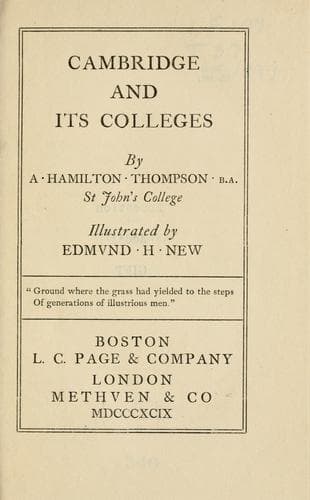
Cambridge and Its CollegesThompson, A. Hamilton (Alexander Hamilton)
History
Cambridge and Its Colleges
Thompson, A. Hamilton (Alexander Hamilton)
University of Cambridge
In 1589 died an excellent lady, Frances Lady Sussex, widow of the second
Earl. She was the daughter of Sir William Sidney, and would in any case
have achieved a negative distinction as the wife of Thomas Radcliffe and
the aunt of Sir Philip Sidney. But in her will she left a legacy of
five thousand pounds, to be employed by her executors in the foundation
of a college at Cambridge, or, in case the bequest were insufficient,
in enlarging Clare Hall. Six years later, the executors bought a site
from Trinity College. When Henry VIII. founded Trinity, he made over to
it the lands of the Franciscan Friary which, until the dissolution, had
occupied the space between the modern Sidney Street and the King’s Ditch.
The buildings were apparently taken down and used as a quarry for Henry’s
new college. Thus the site was vacant, and the executors, after making
a preliminary payment of a hundred marks, took over the ground on a
perpetual lease, and engaged to pay a rent of £13. 6s. 8d. yearly. These
executors, the actual founders of Sidney, were the Earl of Kent and Sir
John Harrington, the translator of Ariosto. The college was called the
College of the Lady Frances Sidney Sussex, and took her arms, Radcliffe
impaling Sidney. The pheon, the heraldic symbol of the Sidneys, is the
badge of the college, and, like the eagle of St John’s and the silver
crescent of Trinity Hall, has given its title to the college magazine of
our own days.
The first master was appointed in 1598. He was Dr James Montagu,* and
became Bishop of Winchester, where he died in 1618. But, in spite of
this augury, the history of Sidney is the reverse of prelatical. Of
late years, the college has somewhat retrieved its past record, but,
on the whole, its distinction is Puritan. It is, however, a college
whose history finds its centre in one event, and that event is vague and
shadowy. In the college books, under the date April 23rd, 1616, is the
following inscription, “Oliverus Cromwell, Huntingdoniensis, admissus ad
commensum sociorum Aprilis vicesimo sexto; Tutore Magᵒ Ricardo Howlet.”
Few colleges boast such a fellow-commoner. The note which follows,
written in after years by a good Royalist, is worth transcribing: “Hic
fuit grandis ille impostor, carnifex perditissimus, qui, pientissimo
rege Carolo primo nefaria caede sublato, ipsum usurpavit thronum, et
tria regna per quinque ferme annorum spatium, sub protectoris nomine,
indomita tyrannide vexavit.” Vexavit, as Polonius would say, is good. No
language is more abusive than aptly handled Latin! This “big impostor
and most damn’d butcher” stayed at Cambridge till July, 1617, and then,
like many great men, left without taking his degree. His contribution to
the social life of his college has been stigmatised as discreditable,
but this is probably invidious rumour and nothing more. The window of
his room—which, by the way, dates from 1827 or thereabout—is still shown
to the credulous. There is an admirable portrait of him in the hall,
Public-domain text, read in full here on John Shaqi.
Reviews
Reviews
No reviews yet
Be the first to share your thoughts on this work.
Elsewhere in the archive
Join the Discussion
Join the discussion
Sign in to leave a comment or review.
Sign InorCreate an account