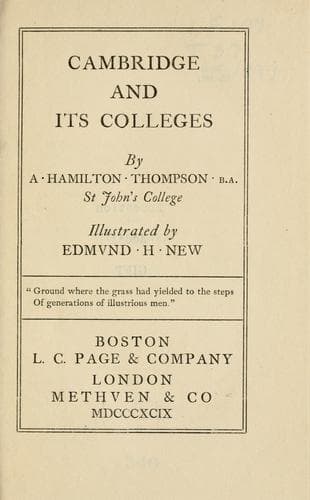
Cambridge and Its CollegesThompson, A. Hamilton (Alexander Hamilton)
History
Cambridge and Its Colleges
Thompson, A. Hamilton (Alexander Hamilton)
University of Cambridge
The memory of George Augustus Selwyn, the great Bishop, first of
Melanesia, afterwards of Lichfield, is honoured in Cambridge by the
latest of all the colleges. Selwyn, one of a famous Cambridge family,
died in 1877; and in 1882, Selwyn College was opened. The object of the
college is that which had, some time before, prompted the foundation
of Keble—the provision of University education at a more moderate rate
than had hitherto been the case. It is conducted on what is known as the
hostel system; that is to say, its members, while enjoying all University
privileges, have all their meals in common, and are supplied with most
necessaries at fixed rates from the college buttery. This is, we may
believe, the simple system out of which great foundations like Trinity
grew; and, since Selwyn began it, one or two other colleges have pursued
it with some success on a voluntary principle. At Selwyn, however, the
hostel life is compulsory; and the college is known officially as Selwyn
Hostel. It has not lived long enough to produce any great sons as yet,
but its record is honourable, and we may expect much from it in the
future.[8] Its buildings, forming two sides of a quadrangle, are of red
brick, and were designed by Sir Arthur Blomfield, who also built the
Master’s Lodge at the east corner of the enclosure. As the essence of
the college’s existence is to provide accommodation for students, the
buildings are devoted to rooms, and the Hall and Chapel were left to
the last. For the first thirteen years of the history of the college,
these necessities of college life were supplied by the low range of
temporary buildings just inside the entrance gate. There, too, for some
time to come the Hall will have to remain, a very simple room, whose only
ornament is the portrait of Mr Arthur Lyttelton, late master and now
vicar of Eccles. This, by Mr C. W. Furse, is a striking example of the
New English school. In 1895, however, one of the wishes of the college
was fulfilled, and the present noble Chapel was erected from Sir Arthur
Blomfield’s design. It stands north of the Master’s Lodge, and is a
very large and lofty building of red brick, with freestone dressings.
The style is a free adaptation of English Perpendicular, the admirable
window tracery being a remarkable feature. The interior is very good,
and the very complete set of stalls, with their grotesque carvings and
modern misereres, would do honour to a medieval collegiate church. Its
consecration by the Bishop of Ely in October, 1895, was one of the most
imposing ceremonies which have been seen of late years in Cambridge. The
late Archbishop of Canterbury and several other prelates assisted at the
function, and the sermon at mid-day was preached by the Archbishop. If
the pious founders of the older colleges had been able to be present,
and had seen the whole college walk in procession round the quadrangle
in the early morning, singing the sixty-eighth psalm, and had assisted
Public-domain text, read in full here on John Shaqi.
Reviews
Reviews
No reviews yet
Be the first to share your thoughts on this work.
Elsewhere in the archive
Join the Discussion
Join the discussion
Sign in to leave a comment or review.
Sign InorCreate an account