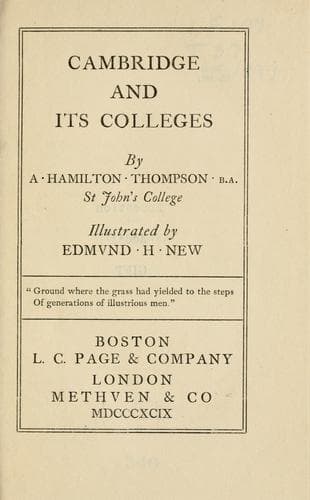
Cambridge and Its CollegesThompson, A. Hamilton (Alexander Hamilton)
History
Cambridge and Its Colleges
Thompson, A. Hamilton (Alexander Hamilton)
University of Cambridge
at the celebration of the Holy Eucharist which followed, they would
assuredly have thanked God that the traditions of their Church and of the
University which was its daughter were preserved and cherished by more
modern foundations.
Ridley Hall represents a school of thought somewhat different from that
to which Selwyn owes its being, and is altogether a modern development in
University life. Like Selwyn, it has an Oxford counterpart in Wycliffe
Hall. It was founded in 1879 as a training college for those who, having
already graduated from some college, wish to proceed to Holy Orders.
Under the headship of Doctor Moule, it has already sent out several
distinguished members of the Evangelical party, and has also been of
great service to missionary societies. It has certainly proved itself a
power in modern Cambridge, chiefly through the influence of its eminent
principal; and has encouraged other religious bodies to attempt what is
an accomplished fact in Oxford. The Presbyterian body are now building
themselves a large theological college at the corner of the Madingley
Road. The buildings of Ridley are not unlike those of Selwyn, and the
Renaissance chapel with its picturesque iron turret is a pleasing
object from most points of view. The architect of the older portion was
Mr Charles Luck; the chapel and southern range were designed by Mr W.
Wallace.
After many vicissitudes, Ayerst Hall has at length disappeared. Some
years ago the Rev. W. Ayerst of Caius College established a small college
on the hostel principle, which occupied the buildings now known as Queen
Anne’s Terrace, between Parker’s Piece and the University Cricket Ground.
In 1894 his students vacated these buildings for a new range between
the Huntingdon and Madingley Roads, and their original home is now the
offices of the University Correspondence College. Rather less than three
years later, the venture was abandoned, and the new buildings were
purchased for a colony of Benedictines. Since the building of the great
church of Our Lady of the Assumption and the English Martyrs, which is
so conspicuous a feature from the railway, the influx of Roman Catholic
students has been much greater. In 1896 a Roman Catholic chaplaincy was
founded in both Universities. The direct result of this measure was the
purchase of Ayerst Hall and the establishment of a theological school for
Roman Catholic undergraduates. This scheme is in its infancy, and its
future remains to be seen. The new hostel is known as Edmund House.
Public-domain text, read in full here on John Shaqi.
Reviews
Reviews
No reviews yet
Be the first to share your thoughts on this work.
Elsewhere in the archive
Join the Discussion
Join the discussion
Sign in to leave a comment or review.
Sign InorCreate an account