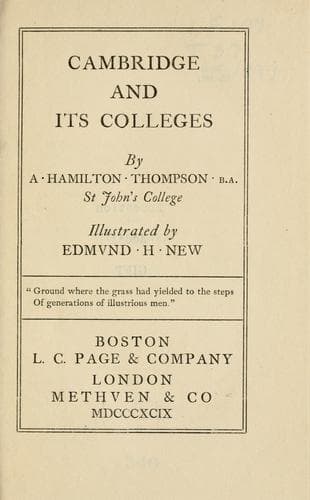
Cambridge and Its CollegesThompson, A. Hamilton (Alexander Hamilton)
History
Cambridge and Its Colleges
Thompson, A. Hamilton (Alexander Hamilton)
University of Cambridge
Another abortive attempt was Cavendish College, founded in 1882, which
took its name and coat-of-arms from the late Duke of Devonshire. By an
irony of fate, it is the only collegiate building which the passer-by
sees from the train—that is, unless he keeps a sharp lookout for King’s
Chapel. It was, however, a mile from the nearest college, on the furthest
outskirts of the town, and, after a precarious existence, it failed and
was closed in 1891. Between 1891 and 1895 the curious might roam through
its halls unchecked, inspect the deserted library and the singularly
comfortable buildings, and muse on the names of departed occupants
inscribed on the staircases. Some of its students went down; others
joined other colleges. In 1895 it was bought by Mr J. C. Horobin of
Homerton, who transferred to it his training-college for schoolmasters
and schoolmistresses. Its part in University life is not over yet,
but its proud title has been exchanged for the more suburban name of
Homerton, and now only old-fashioned people call it Cavendish.
Lastly, there is Fitzwilliam Hall. The same desire which led to the
foundation of Selwyn and Keble led to the passing of a grace by the
Senate of both Universities, by which students were allowed to become
members of the University without joining any particular college.
Unattached students now form a considerable element at both Oxford and
Cambridge. The necessity for a certain amount of combination goes,
nevertheless, without saying; and its result is Fitzwilliam Hall. A
house opposite the Fitzwilliam Museum has been purchased, and has been
turned into a club for non-collegiate students. There are a reading-room,
lecture rooms, and rooms for the tutors, who are, for the most part,
distinguished members of the older foundations. The non-collegiates
have their own gown, their boat on the river, and their own clubs and
societies; and, although some of their most promising members in time
join other colleges, they have a distinct corporate life and status of
their own. Thus, although Cambridge has in none of these respects been
in front of her traditionally conservative sister, she has at all events
followed not very far behind her in any.
XXI
GIRTON AND NEWNHAM
Public-domain text, read in full here on John Shaqi.
Reviews
Reviews
No reviews yet
Be the first to share your thoughts on this work.
Elsewhere in the archive
Join the Discussion
Join the discussion
Sign in to leave a comment or review.
Sign InorCreate an account