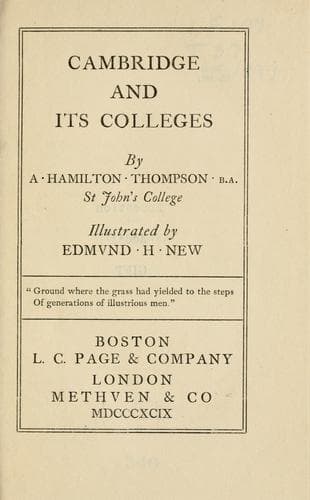
Cambridge and Its CollegesThompson, A. Hamilton (Alexander Hamilton)
History
Cambridge and Its Colleges
Thompson, A. Hamilton (Alexander Hamilton)
University of Cambridge
In spite of the misfortunes which it brought about, the Senate House is
one of those buildings which gave Cambridge its greatest dignity. One
may hesitate to compare it with the Radcliffe Library at Oxford, which
was finished about twenty-five years later, but it is largely due to
the same architect and is certainly an addition to his credit. Gibbs
had, however, only a small share in the work, for Burrough is its real
designer. It is an oblong building, with entrances on the east and on the
middle of the south sides. It has a double range of windows throughout,
save on the west side, where they are blank. Those in the upper storey
are round-headed, those in the lower are square-headed and are surmounted
by plain architraves, alternately round and pointed. The whole building
is surrounded by an order of composite pilasters, cut square save near
the doors, where they are round and fluted. Above the cornice is a
balustrade, broken judiciously by the pediments of the entrances, which
give the building its distinctive feature. The whole is one of the best
specimens of early Georgian architecture in England, and the interior
is perfectly consonant with the simple grandeur of the outside. The oak
galleries suit the building admirably. At the east end, near the door,
are the statues of the Duke of Somerset, Chancellor at the Revolution,
and of William Pitt: the first by Rysbrack, the second by Nollekens.
After the Senate House, geographically and in point of time, comes the
Pitt Press in Trumpington Street, a very glorious achievement of the
early Gothic revivalists. Mr Bowes’ list, published a year or two ago,
is the monumental record of Cambridge printing, but, when the Pitt Press
was founded, the traditions of John Siborch, who had set up a press
in the University about 1521, had been almost forgotten. Even since
then, the Pitt Press, although the parent of Professor Jebb’s edition
of Sophocles and other masterpieces of erudition, has scarcely proved
itself the rival of the Clarendon. Its origin is curious. After the Great
Commoner’s death, a subscription fund was started to commemorate him,
the immediate results of which were the statues in Westminster Abbey and
Hanover Square. The rest of the money was employed in building the Pitt
Press. In the chronological order of works of the date, it stands just
after Wilkins’ screen at King’s, and just before Rickman’s court at St
John’s. Its architect was Edward Blore, and it was finished in 1833. It
is not uglier than most buildings of the period, and the gateway tower
looks well at a sufficient distance. This tower, by the way, has often
given rise to the impression that it is an ecclesiastical building of
some kind, and it is known generally as the “freshman’s church.” The hoax
used at one time to be practised on unsuspecting young gentlemen during
their early days of residence, but the epithet is now too well known to
be misleading.
Public-domain text, read in full here on John Shaqi.
Reviews
Reviews
No reviews yet
Be the first to share your thoughts on this work.
Elsewhere in the archive
Join the Discussion
Join the discussion
Sign in to leave a comment or review.
Sign InorCreate an account