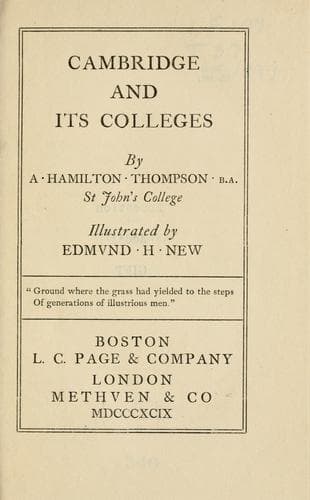
Cambridge and Its CollegesThompson, A. Hamilton (Alexander Hamilton)
History
Cambridge and Its Colleges
Thompson, A. Hamilton (Alexander Hamilton)
University of Cambridge
Further on, and on the same side of Trumpington Street, is the
Fitzwilliam Museum. In 1816 died Richard, Viscount Fitzwilliam, who
bequeathed his library and pictures to the University. He left also
£100,000 for the building of a museum to receive them. His princely
benefaction was, of course, accepted; and, pending the erection of
a building, the collections were deposited in the old Perse School,
now the Engineering Laboratory. Building was not begun till late in
the thirties, when Basevi was employed to execute the present design.
Basevi, however, fell from the great tower of Ely before the work was
finished, and what he had begun was continued by Mr Cockerell. This
architect had earned a dubiously just reputation for his proceedings
at the University Library; here he had an excellent plan to work on,
and did justice to it. The Fitzwilliam Museum, with the exception of
certain decorations, was completed in 1847; the collections, augmented
meanwhile by private bequests, were brought from the Perse School in
1848. Differences of opinion exist as to the merit of the building
and the collections, but there can be no doubt that the façade is,
after that of St Paul’s, one of the best of its kind anywhere. It is
astonishingly good for its period. The decoration of the entrance hall is
splendid but meretricious, and the lavish profusion of coloured marbles
is almost suspicious. A statue of the Prince Consort is the cynosure of
this brilliancy, and there is a portrait of him in the basement, dressed
in his Chancellor’s robes, with a red curtain and the great gate of
Trinity in the background. For the most part the basement is devoted to
the University Museum of Antiquities, the nucleus of which was bequeathed
by Samuel Disney of the Hyde, Essex. In memory of this gentleman has
been founded the Disney Professorship of Archæology. On the ground-floor
also is the valuable Fitzwilliam Library, and a very perfect library of
musical works. In one of the rooms part of the valuable collection of
engravings is exhibited. This comprises specimens of early Flemish and
German artists, Albert Dürer, the Little Masters of Germany, and most
of the best workers in wood-cut, steel-engraving, and mezzotint. Others
may be found upstairs among the pictures. The pictures are of various
merit, and many are copies. The fine Paul Veronese, “Mercury turning
Aglauros into stone,” which faces the principal door of the west gallery,
is undoubtedly genuine, and there are some good examples of the Venetian
school, especially two small pictures attributed to Palma the younger.
Lovers of early Italian art will find a small Madonna and Child by
Pinturicchio, while the disciples of the now unpopular Bolognese school
will admire the picture of St Roch and the Angel, by Annibale Caracci.
The room also contains a doubtful Rembrandt, two exquisitely finished
little pictures by Gerard Douw, some good Ruysdaels, a Teniers or two,
Public-domain text, read in full here on John Shaqi.
Reviews
Reviews
No reviews yet
Be the first to share your thoughts on this work.
Elsewhere in the archive
Join the Discussion
Join the discussion
Sign in to leave a comment or review.
Sign InorCreate an account