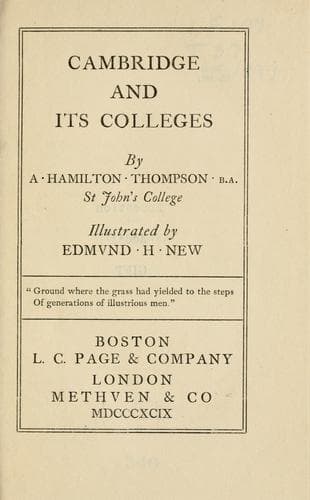
Cambridge and Its CollegesThompson, A. Hamilton (Alexander Hamilton)
History
Cambridge and Its Colleges
Thompson, A. Hamilton (Alexander Hamilton)
University of Cambridge
Since the days of Lord Fitzwilliam’s bequest, the University’s ardour has
been turned in the direction of science. Most of the public buildings
since then, such as the huge laboratories and Anatomical Museum (a work
of Salvin’s) are devoted to that interest, and the visitor will find them
more utilitarian than anything else. In speaking of Pembroke, I have
already referred to Mr Scott’s façade to the Chemical Laboratory. The
archæologist, however, will be greatly relieved to find the beautiful
timber roof of the Perse school still existing where he least expects
it—namely, in the Engineering Laboratory. These buildings, however, and
others, such as the Observatory in the Madingley Road, and Sir Digby
Wyatt’s extraordinary façade at Addenbrooke’s Hospital, which, the famous
“Cambridge Freshman” was gravely informed, was the Vice-Chancellor’s
official residence, speak for themselves. Not the least important feature
of modern Cambridge is the unobtrusive red-brick building in Mill Lane,
occupied by the University Extension Syndicate. Not remarkable in itself,
it is the visible sign of the aim of the modern University not to keep
its cherished learning to itself, but to distribute its advantages to
others. Whether or no the idea expressed by a far-sighted don in the
last century, when he said that each town ought to have its university,
will be realised, is a possibility that rests on the knees of the gods;
but the means are certainly in use, and the wish is in a fair way of
fulfilment.
XXIII
THE CHURCHES OF CAMBRIDGE
Although the architectural interest of Cambridge, so far as churches are
concerned, is centred in the college chapels, there are nevertheless
several churches which are not devoid of interest, and one or two which
are quite unique. The visitor who takes the trouble to examine them will
be amply repaid, although his reminiscences of them will, after a cursory
inspection, be rather confused. Starting, then, from the western door
of the University Church, and proceeding along King’s Parade, he will
find, just opposite King’s gateway, the narrow passage which leads to
St Edward’s Church. St Edward’s occupies the centre of a flagged court,
and its east end faces Peas Hill, one of those Cambridge hills whose
slope is invisible. It is a fairly large church with broad aisles and a
short tower at the west end, and is mostly of the Decorated period, from
1340 to 1350; but it has been from time to time restored, and the tower
suffers from a hideous coating of stucco. The nave arcade is lofty but
rather meagre. The font is interesting, and was restored by the Cambridge
Camden Society in the first half of the century. There are also good
Decorated sedilia in the chancel. It was one of the centres of reforming
influence in Cambridge, and many of the Marian martyrs, including
Latimer, preached in it.
Public-domain text, read in full here on John Shaqi.
Reviews
Reviews
No reviews yet
Be the first to share your thoughts on this work.
Elsewhere in the archive
Join the Discussion
Join the discussion
Sign in to leave a comment or review.
Sign InorCreate an account