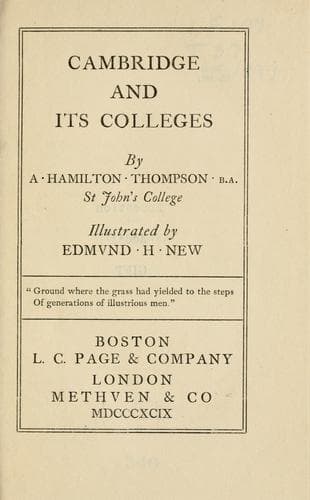
Cambridge and Its CollegesThompson, A. Hamilton (Alexander Hamilton)
History
Cambridge and Its Colleges
Thompson, A. Hamilton (Alexander Hamilton)
University of Cambridge
and a picture which, legend says, is the earliest Murillo in existence.
There are also portraits by Gainsborough and Hogarth.
The south room is even more miscellaneous. It is presided over by a vast
copy of a Veronese, probably by the artist’s brother, opposite which,
on either side of the entrance from the main gallery, are two portraits
of the school of Holbein, one of a bygone Fitzwilliam. The other was
given by the executors of the late Dean of Lincoln, and represents a
person unknown. Besides these, there are numerous small pictures of the
late Italian type, and views of Venice by Canaletto and Zuccarelli. A
very admirable Raeburn will appeal to all lovers of portrait art, and
deserves wider fame. But the gem of the whole collection, a series of
water-colours by Turner, is in this room. Mr Ruskin generously presented
the University with these, and they may be reckoned among its most
priceless treasures. In the eastern continuation of the room is the
collection of small pictures given by Mr Daniel Mesman in 1834. Some
of these, including a small landscape attributed to Ruysdael and some
delicate pictures by Adam Elzheimer, are of considerable value; but the
rest are somewhat devoid of interest. On the south wall is a set of small
pictures of the French school, mostly by Boucher, but two are attributed
to Watteau, and two to Greuze. They are, however, of no great worth. And
the rooms on the opposite side of the building are very uninteresting.
Sir John Millais’ famous “Bridesmaid” is in the western room of the two,
in company with some English landscapes, Mr Watts’ portrait of the late
Duke of Devonshire, and Mr Richmond’s portrait of the present Bishop
of Durham. The eastern room is occupied by an immense model of the Taj
Mehál, and by some very early Italian pictures, the most prominent of
which is by Cosimo Rosselli, the painter whose startling use of colour
was so acceptable to Pope Sixtus IV. Under the curatorship of Professor
Colvin and the late Professor Middleton, the interest of the Museum
was much increased; and the present curator, Dr James, the well-known
theologian and antiquarian, has followed in their footsteps.
Public-domain text, read in full here on John Shaqi.
Reviews
Reviews
No reviews yet
Be the first to share your thoughts on this work.
Elsewhere in the archive
Join the Discussion
Join the discussion
Sign in to leave a comment or review.
Sign InorCreate an account