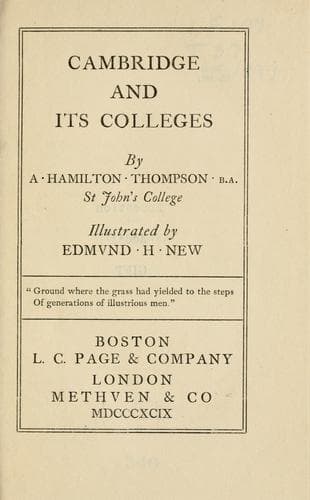
Cambridge and Its CollegesThompson, A. Hamilton (Alexander Hamilton)
History
Cambridge and Its Colleges
Thompson, A. Hamilton (Alexander Hamilton)
University of Cambridge
John Overall, Bishop of Lichfield, and afterwards of Norwich, another of
the translators of the Bible, was master from 1598 to 1607. The college
leaned throughout its history to the Puritanic side of the religious
question, and Richard Sibbes, master from 1626 to 1635, is one of
those strongly Puritan divines who had the advantage of an University
education. His evangelical theology, rich in quaint phrase and full of
ingenious learning, is still popular with serious readers, although his
fame has been somewhat overshadowed by the greater names of Bunyan,
Baxter, and John Owen. In spite of this spiritual activity, it appears
that the college was about this time in a very bad and ruinous state,
and, on the side of Trumpington Street, was excessively cramped for room.
During the mastership of John Hills, Sibbes’ predecessor, John Gostlin,
the eccentric master of Caius, gave the Bull Inn, which was his personal
property, to the college, and thus the society was enabled to enlarge
its frontiers. Nevertheless, the commotions of the Civil Wars delayed
operations until long after the Restoration, when Dr John Eachard, master
in 1675, carried out the longed-for improvements. There is no college
whose external appearance belies a medieval foundation more than St
Catharine’s.
Side by side with Sibbes we may reckon the famous Dissenting preacher,
Edmund Calamy, who was also a member of this college and was connected
with Sidney as well. But, after the Restoration and Eachard’s
improvements, St Catharine’s settled down again to its episcopal
traditions. Sir William Dawes, Eachard’s successor from 1697 to 1714, was
a worthy but in no way remarkable Archbishop of York. During his time,
however, the society received a famous member in the militant Benjamin
Hoadly,* Bishop first of Bangor, then of Hereford, then of Salisbury,
and lastly of Winchester. It is curious that Hoadly, the typical
Latitudinarian, as the ugly phrase goes, of his age, and his opponent,
the no less typical High Churchman, William Law, were members of the two
Cambridge colleges which had shown most activity on the Puritan side, St
Catharine’s and Emmanuel. Hoadly’s book, _On the Nature of the Kingdom
and Church of Christ_, is his chief claim to celebrity, as the doctrines
which it advocated gave rise to the Bangorian Controversy and were the
cause of many polemical treatises which have a distinct literary rank.
Public-domain text, read in full here on John Shaqi.
Reviews
Reviews
No reviews yet
Be the first to share your thoughts on this work.
Elsewhere in the archive
Join the Discussion
Join the discussion
Sign in to leave a comment or review.
Sign InorCreate an account