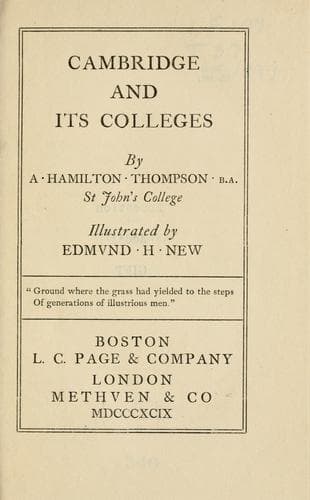
Cambridge and Its CollegesThompson, A. Hamilton (Alexander Hamilton)
History
Cambridge and Its Colleges
Thompson, A. Hamilton (Alexander Hamilton)
University of Cambridge
St Catharine’s is, in a certain sense, the daughter of King’s, for
its founder was Robert Woodlark,* provost of the latter college. The
reason for its foundation is not very obvious: it was probably merely
a pious act on the part of Woodlark, of whom we know very little
beyond this. The site on which it stood occupied the greater part of
that oblong space which still is bounded on the north by King’s Lane
and on the south by Silver (then Small Bridges) Street. Even now the
space is somewhat cramped by houses; then the college was thoroughly
“town-bound,” as Fuller puts it. However, although one of the smallest
colleges in Cambridge, it has given, in comparison with its size, more
famous men to England than any college in either University. These men
are all clergy, and their names are among the most reverend in Church
history. Seventy-four years after the foundation of the college, Edwin
Sandys* became master. He is chiefly known as Archbishop of York and as a
translator of the Bible, and, while in exile abroad during Mary’s reign,
he cultivated friendly relations with foreign Protestant churches. As
Master of St Catharine’s and Vice-Chancellor, he went through a critical
experience, which is narrated by Fuller. The Duke of Northumberland, who
was at Cambridge in the hope of intercepting Mary’s progress from the
Eastern Counties to London, ordered Sandys to preach before him at the
University Church. Sandys was a timid man and had very little faith in
Lady Jane Grey’s cause, so that the order caused him some perplexity. He
rose at a very early hour next morning, and took the _sortes Biblicae_
after the approved manner of the sixteenth century. The text at which
his Bible opened was the sixteenth and seventeenth verses of the
first chapter of Joshua, “All that thou commandest us we will do, and
whithersoever thou sendest us we will go. According as we hearkened
unto Moses in all things, so will we hearken unto thee: only the Lord
thy God be with thee, as he was with Moses.” He preached from this text
in so politic a manner that no one could find a handle of accusation
against him. The exacting Northumberland came back to Cambridge after
a short tour in Suffolk, well aware that his enterprise was over, and
with the forlorn hope that, if he proclaimed Mary queen, he might win
his pardon. He invited Sandys to join in the proclamation with him, but
the Vice-Chancellor refused with an answer that must have been a very
cold comfort to Northumberland. The Duke, however, went through the
business mechanically at the old Market Cross, and was arrested very soon
afterwards at his lodgings in King’s. Sandys escaped to the Netherlands,
and returned when Elizabeth came to the throne. He is buried at
Southwell, where the archbishops of York had one of their palaces.
Public-domain text, read in full here on John Shaqi.
Reviews
Reviews
No reviews yet
Be the first to share your thoughts on this work.
Elsewhere in the archive
Join the Discussion
Join the discussion
Sign in to leave a comment or review.
Sign InorCreate an account