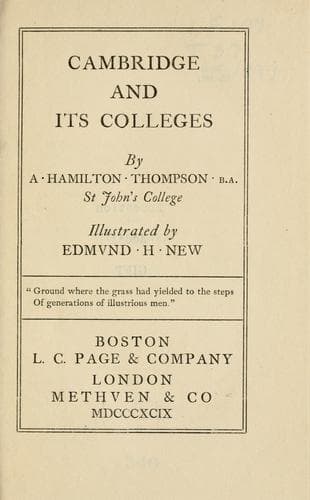
Cambridge and Its CollegesThompson, A. Hamilton (Alexander Hamilton)
History
Cambridge and Its Colleges
Thompson, A. Hamilton (Alexander Hamilton)
University of Cambridge
Bishop Alcock’s gate-tower, a few years earlier than those of Christ’s
and St John’s, and almost contemporary with that of Queens’, forms a
charming prelude to this beautiful college. Its stepped battlements are
original, and its plan is more domestic than those of the other towers,
which have a very monastic appearance. The founder’s coat-of-arms, the
three cocks which the college has ever since borne as its cognisance,
appear on various parts of the tower and in the roof of the gateway;
but the statue of Bishop Alcock and a good deal of the decoration are
new.[5] The tower is the entrance to the outer court of the college,
whose ivy-grown buildings date from 1641. They are very fair late Gothic
work and carefully follow Alcock’s tower in their general lines; they are
due to Richard Sterne (master, 1633-1644 and again in 1660), but they
were not actually finished until the beginning of George the First’s
reign. They occupy three sides of the court; the western side is open,
affording a good view of the towers in the centre of the town. From the
opposite side a low postern gateway (part of the original work) leads
into the inner court of the college, round which the public buildings
are situated. The Hall is on the north side; opposite it is the Master’s
Lodge and the nave of the chapel. The Library occupies the west side, and
the northern transept of the chapel the east side. This was originally
the cloister of the nunnery which was superseded by the college. The
cloisters which exist are subsequent to the founding of the college,
and for some time were shut in, like those at Wilton House. In the last
century, however, they were opened to the court, and now they are simply
of the ordinary covered type, without any wall of partition. A few years
ago, while repairs were being carried on in the eastern wall of these
cloisters, just north of the transept-end of the chapel, a beautiful
triple arch of the Early English period was laid open, and may now be
examined. This was probably the entrance to the nuns’ chapter-house. It
is a very unique and delicate piece of work, dating probably from about
1240, and compares very well with the excellent work of that period to be
found in Cambridgeshire.
Public-domain text, read in full here on John Shaqi.
Reviews
Reviews
No reviews yet
Be the first to share your thoughts on this work.
Elsewhere in the archive
Join the Discussion
Join the discussion
Sign in to leave a comment or review.
Sign InorCreate an account