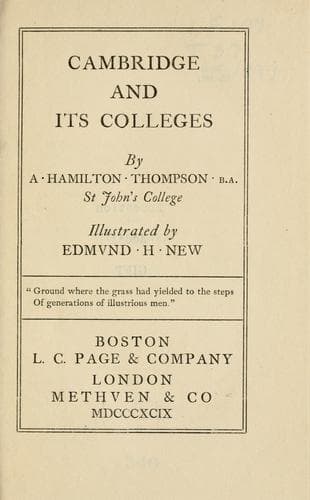
Cambridge and Its CollegesThompson, A. Hamilton (Alexander Hamilton)
History
Cambridge and Its Colleges
Thompson, A. Hamilton (Alexander Hamilton)
University of Cambridge
Part of the chapel dates from the foundation of the nunnery, but a great
deal of it is Early English, and the whole building was remodelled by
Alcock on the collegiate principle. He seems to have cut away the aisles
of the convent church, leaving only the north choir aisle; he left the
transepts unchanged, save for a set of Perpendicular windows with scanty
tracery, which are repeated in the nave and choir. His east window has
been taken away and the Early English triplet restored. He thus made an
ordinary monastic building into an aisleless cruciform church, differing
from a college chapel only in that it retains a nave, in which respect it
is unique. He also added the Perpendicular upper storey to the central
tower, the lower half of which is Early English, and corresponds in
its interior arcading with the arches in the cloister. The upper storey
of this earlier tower had fallen in 1297. On the whole, one can hardly
give unqualified praise to Alcock for his treatment of the building,
but he made it answer his purposes very well. Moreover, he gave it some
beautiful stalls and a screen. Unfortunately, these ornaments offended
Georgian taste. The restoration of the chapel in the last century was a
wonderful proceeding. The walls were daubed with yellow relieved by a
low black dado, the ceiling was plastered, the best part of the woodwork
was removed to Landbeach Church, five miles on the way to Ely, and the
central lantern was closed up, so that the fine arcade was completely
hidden. To-day, however, we are able to see the chapel without these
encumbrances, for the restoration, begun in 1845 and continued to our
own day, has made it the most historical interior in Cambridge. The
south transept with its eastern gallery is for the most part Norman of
a very simple order, coeval with the foundation of the monastery. The
central tower, the choir and chancel are Early English, save for Alcock’s
additions on the south side, and the remaining aisle, which contains
Decorated work. The arcaded lancets on the north side of the chancel
should be noticed: this singularly graceful arrangement is almost unique.
There is, however, an example, completer and perhaps finer, at Cherry
Hinton, within an hour’s walk of Cambridge. Another specimen of local
work is the double piscina, whose splendid mouldings, crossing each other
in the head of the arch, and reminding one of well-folded linen, are
only to be found in three or four churches in, or immediately round the
town. I have spoken of Alcock’s Perpendicular work, which is of a kind
more domestic than ecclesiastical. The stalls and screen are rather more
than forty years old, but they show a taste of a kind unusual at that
time, and are much improved by the dim light of the whole building. This
dimness is due to the stained glass, which is all modern. The glass in
the lancets is by Hardman; it is not very good, but it is unobtrusive.
That in Alcock’s two choir windows was put in rather earlier by the
Public-domain text, read in full here on John Shaqi.
Reviews
Reviews
No reviews yet
Be the first to share your thoughts on this work.
Elsewhere in the archive
Join the Discussion
Join the discussion
Sign in to leave a comment or review.
Sign InorCreate an account