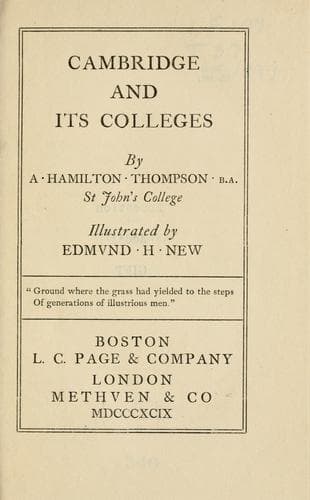
Cambridge and Its CollegesThompson, A. Hamilton (Alexander Hamilton)
History
Cambridge and Its Colleges
Thompson, A. Hamilton (Alexander Hamilton)
University of Cambridge
The masters of the eighteenth century were, for the most part, stately
and important men who received a great deal of promotion. Dr Charles
Ashton, of whom the college possesses two portraits, was master for
fifty-one years, from 1701 to 1752. In his time there was at Jesus a
whilom famous scholar, Dr John Jortin,* to whom we owe the very careful
but extremely dull life of Erasmus. He was a popular divine, and combined
the lucrative posts of Archdeacon of London, Rector of St Dunstan’s in
the East, and Vicar of Kensington. Dr Ashton was succeeded by Dr Philip
Yonge, who was master for six years, and was then made Bishop of Bristol,
being eventually translated to Norwich in 1761. His portrait in the
Master’s Lodge is said to be by Reynolds. His successor, Dr Lynford Caryl
(* from a portrait by Wright of Derby), is remarkable for little save his
picturesque name. He, in his turn, give place to Richard Beadon,* who was
removed to Gloucester in 1789 and died as Bishop of Bath and Wells in
1824.
When Dr William Pearce (* Beechey) was Master—he was also Master of
the Temple and Dean of Ely—Samuel Taylor Coleridge (* from Washington
Allston) came into residence. Coleridge was two years younger than
Wordsworth, and came up after the elder poet had gone abroad to watch the
French Revolution. Less fortunate than Wordsworth, he left Cambridge in
1794 without his degree, in this anticipating Tennyson. Like most poets,
he formed few friendships while at Cambridge, and took no considerable
part in the academic life of his day. Milton, whose genius was eminently
academic, is the exception to this rule. We find it difficult, on the
other hand, to look upon Coleridge as an University man, and the same
difficulty would occur with regard to Wordsworth, were it not for his
minute account of his life at St John’s. Shelley, also, who was twenty
years younger than Coleridge, took no degree at Oxford. Nevertheless,
the colleges of these unsatisfactory students have, since their death,
conspired to honour them, and doubtless to many Jesus men Coleridge is
their _genius loci_ very much as Shelley is to men at University College.
Public-domain text, read in full here on John Shaqi.
Reviews
Reviews
No reviews yet
Be the first to share your thoughts on this work.
Elsewhere in the archive
Join the Discussion
Join the discussion
Sign in to leave a comment or review.
Sign InorCreate an account