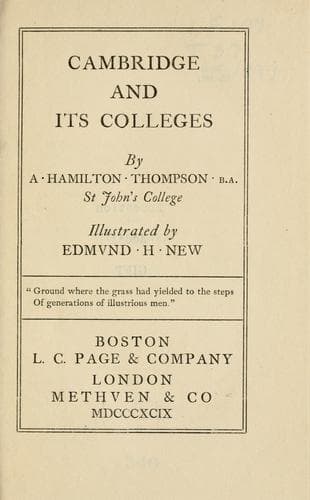
Cambridge and Its CollegesThompson, A. Hamilton (Alexander Hamilton)
History
Cambridge and Its Colleges
Thompson, A. Hamilton (Alexander Hamilton)
University of Cambridge
Dr Clarke, Professor of Mineralogy (* Opie) was a contemporary of
Coleridge who preferred to close his University life in the orthodox
way. He died in 1822, when Dr French* had succeeded Dr Pearce in the
mastership. The days of ecclesiastical preferment ceased with Dr Pearce,
and his successors were content to hold quiet country livings with
their mastership. This was the case with the late master, Dr Corrie,*
who divided his time between the college and his pleasant rectory of
Newton-in-the-Isle. The last ten years of his rule were remarkable for
the supremacy of Jesus as head of the river, when the college was full
of oarsmen like Mr Shafto and the late Mr Edward Prest. It is matter of
history how, when the boat “went down” for the first time in ten years,
the Jesus men appeared on the river and the towing-path in mourning.
In 1885 Dr Morgan (* Collier), the brother of a celebrated Oxford
man, the late Sir George Osborne Morgan, became master, and under him
the college, if less successful on the river, has preserved its old
reputation. Among the modern sons of the college we should remember Dr
Wilkinson,* the present Anglican Bishop in North and Central Europe,
originally Missionary Bishop in Zululand, and the Rev. Osmond Fisher,*
Honorary Fellow, to whose antiquarian zeal the college is indebted for
the excavation of its monastic remains.
XIII
CHRIST’S COLLEGE
[Illustration: Christ’s College]
Christ’s may be cited as a fair specimen of the normal Cambridge college.
Its court and gate-tower have suffered considerably since they were
first built, having been recased with stone in 1724. This pious work
was undertaken with funds supplied by Dr Thomas Lynford, fellow of
the college and Archdeacon of Barnstaple, and is as well done as one
can expect of anything so radical. Two years later, the west front of
Pembroke was treated in the same way, and the two may be cited together
as in some measure a vindication of the early Georgian restorer. All
that was done was to make the face of the college flat and remove all
superficial irregularities, while the general lines of the building were
scrupulously maintained. Dr Lynford is not responsible for the interior
of the court, which belongs to a later part of the century, and is due
to Essex or one of his kind. Originally, we may imagine a quadrangle
of dark red brick, very like the courts at St John’s and Queens’. The
gate-towers of all three colleges are very similar; in that of Christ’s
the foundress’ statue is a modern addition. The present chapel, north
of the court, is substantially the chapel of Lady Margaret Beaufort’s
foundation, and the small vestries are partly of that date. As for the
rest, it is very good work of the middle of the last century imposed
on Italian Gothic, and the antechapel, with its wooden columns, is
admirable. Above the altar is a good window by some German or Flemish
artist, not unlike the east window at Peterhouse, and of much the same
period.
Public-domain text, read in full here on John Shaqi.
Reviews
Reviews
No reviews yet
Be the first to share your thoughts on this work.
Elsewhere in the archive
Join the Discussion
Join the discussion
Sign in to leave a comment or review.
Sign InorCreate an account