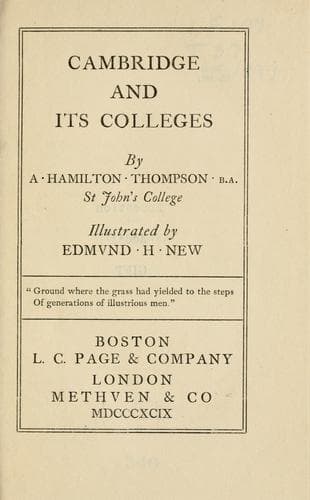
Cambridge and Its CollegesThompson, A. Hamilton (Alexander Hamilton)
History
Cambridge and Its Colleges
Thompson, A. Hamilton (Alexander Hamilton)
University of Cambridge
It may or may not be true that the foundress had rooms reserved for her
use in the Master’s Lodge. The story seems contrary to the spirit of
that age or of any other, but a point may have been stretched in her
favour. The testimony for this legend rests upon an anecdote told by
Fuller. “The Lady Margaret,” he says, “once … came to Christ’s College to
behold it when partly built, and looking out of a window, saw the dean
call a faulty scholar to correction, to whom she said ‘lente, lente,’
gently, gently, as accounting it better to mitigate his punishment than
to procure his pardon; mercy and justice making the best medley to
offenders.” This is scarcely sufficient authority for the tradition.
There are no less than four portraits of the Lady Margaret in the
college, the best of which is perhaps that at the west end of the chapel,
closely resembling the picture in the hall at St John’s. The Combination
Room also contains a portrait of Bishop Fisher, and both these pious
friends of learning are commemorated in the oriel of the Hall. From
the foundation of the college onwards, its history has been peaceful
and comparatively uneventful. In its early years, it seems to have
anticipated the lodging-house system, for we are told that some of the
scholars were lodged in the Brazen George, an inn opposite the college,
and that the doors of this hostelry were closed and opened at the same
time as the doors of the college.
Leland the antiquary and Hugh Latimer were among the earlier members of
the college. But the history of Christ’s is centred in one event, the
seven years’ residence of John Milton, who entered as a pensioner in
1625, and went down with his Master’s degree in 1632. “John Milton of
London,” the entry runs in English “son of John Milton, was initialed in
the elements of letters under Mr Gill, Master of St Paul’s School; was
admitted a lesser pensioner Feb. 12th, 1624 [O.S.] under Mr Chappell, and
paid entrance fee 10s.” Mr Chappell, on the authority of Dr Johnson, is
said to have flogged the poet. “There is reason to believe that Milton
was regarded in his college with no great fondness. That he obtained no
fellowship is certain, but the unkindness with which he was treated was
not merely negative.” Milton himself says enough to make the truth of
this statement at least doubtful; for his language, ten years after his
departure from Cambridge, is not merely the language of a man who had
forgotten old grudges, but breathes a lively affection for his college.
The flogging possibly took place; the University was then nothing but
a large public school, and each college was a separate boarding-house.
Milton, when he went up, was just sixteen, and boys of sixteen are not
past flogging. If he went down without a fellowship, he was surely, in
spite of that, a most promising student. His Latin verses, which we still
read as we read Ovid and Propertius, are the finest poetry, and not mere
Public-domain text, read in full here on John Shaqi.
Reviews
Reviews
No reviews yet
Be the first to share your thoughts on this work.
Elsewhere in the archive
Join the Discussion
Join the discussion
Sign in to leave a comment or review.
Sign InorCreate an account