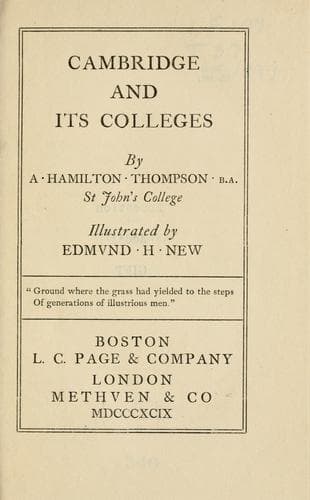
Cambridge and Its CollegesThompson, A. Hamilton (Alexander Hamilton)
History
Cambridge and Its Colleges
Thompson, A. Hamilton (Alexander Hamilton)
University of Cambridge
But the presence of Milton must not allow us to forget the band of
contemplative scholars and philosophers who, in his time, were the
ruling influence in the college, and now lie beneath the chapel floor.
The course of the reformed and Puritan doctrines was largely determined
by the study of Platonic philosophy, just as the Aristotelian system
had allied itself to Catholic theology. Platonism in Cambridge is the
result of two opposing forces: on the positive side, the teaching of
Erasmus; on the negative side, the publication of Hobbes’ _Leviathan_
in 1651. This book received many reputations from Cambridge men; two of
the best known are the work of Dr Bramhall of Sidney, Bishop of Derry
and afterwards Primate of Ireland, and of Dr Cumberland of Magdalene,
the painful Bishop of Peterborough. But the most effective opposition
to Hobbes’ materialistic and mathematical science came from Christ’s.
The first of the Cambridge Platonists was the meditative Mede, who died
in 1638. He was a fellow of the college in Milton’s time, and spent
his days in wandering about the college backs and fields, absorbed in
mystical speculation, of which the eventual outcome was his work on the
Apocalypse. In the evening, members of the college would resort to his
rooms, and he would ask them “_Quid dubitas?_ What doubts have you met in
your studies to-day?” and, having heard their answers, would set their
minds at rest and dismiss them with prayer. But Mede was scarcely so
remarkable as Henry More, the author of the _Mystery of Godliness_ and
other books, who devoted his life at Cambridge to Platonic speculations,
and even extended his enquiries to the Neo-Platonic writers and the
Hebrew Cabala. Ralph Cudworth* was three years his junior, and survived
him one year. This man, the greatest of the company, was Master of
Clare for some time, and, in 1654, became Master of Christ’s, where he
remained, unmoved by the Restoration, till his death in 1688. He was the
most powerful of Hobbes’ adversaries, and his _True Intellectual System
of the Universe_, published in 1678, is a fairly convincing counterblast
to the _Leviathan_. However, Cudworth was rather a talented pedant than
a genius: he lessened the value of his work by recondite allusions, and
his critical capacity was impaired by prejudice. But, in that age of
laborious theology, Cudworth’s book deserves a position next to, although
far below, Leighton’s commentary on St Peter.
Public-domain text, read in full here on John Shaqi.
Reviews
Reviews
No reviews yet
Be the first to share your thoughts on this work.
Elsewhere in the archive
Join the Discussion
Join the discussion
Sign in to leave a comment or review.
Sign InorCreate an account