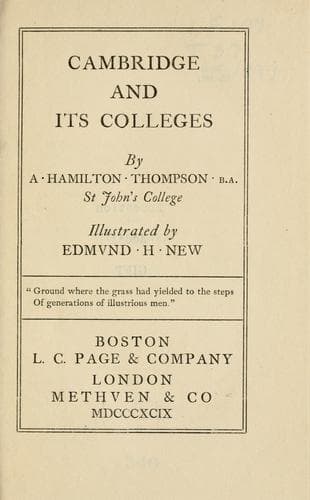
Cambridge and Its CollegesThompson, A. Hamilton (Alexander Hamilton)
History
Cambridge and Its Colleges
Thompson, A. Hamilton (Alexander Hamilton)
University of Cambridge
It is a somewhat melancholy fact that the only other poet of whom
Christ’s can boast besides Milton is that master of tortured conceits,
Francis Quarles. Curiously enough, the portrait, probably of Quarles, in
the Combination Room, which bears the motto “Nec ingratus nec inutilis
videar vixisse” was at one time supposed to be that of Milton. But the
college has had eminent students in other departments. Dr Seth Ward,*
a little younger than Milton, is known as the Bishop of Salisbury
during the time of James II. and the Revolution. In 1766, at the age
of twenty-three, William Paley* was elected a fellow, and remained at
Cambridge for ten years. Paley’s early life is said to have been careless
and riotous. One morning, however, when lying late in bed, a friend and
boon-companion came into his room, and treated him to what is sometimes
known as a “straight talk.” This admonition awakened Paley’s conscience,
and led in time to the publication of the famous _Evidences of
Christianity_ and to the Archdeaconry of Carlisle. In all probability, no
historical name is so often on the undergraduate’s lips—not always with
blessings—as the name of this reclaimed ne’er-do-weel. The _Evidences_,
as is well known, form part of the subjects for the Previous Examination
or Little-Go, and have in this capacity given birth to an especial
department of literature in the shape of “Paley Sheets” and other
_précis_ of the heavy work. A less logical but more human theologian was
John Kaye,* master from 1814 to 1830, and Bishop successively of Bristol
and Lincoln.
If, among statesmen, Christ’s can put forward Lord Liverpool, famous for
his interminable ministry of more than twenty years, she has had in
science, a son who is as famous in his branch of study as Milton is in
poetry. This was Charles Robert Darwin (* Ouless) who came up to Christ’s
in the twenties with the intention of taking holy orders. At Cambridge,
however, he found such opportunities for research that he abandoned his
design, and, at the recommendation of Professor Henslow, who then held
the botanical chair, went out as naturalist to the _Beagle_. This was the
beginning of his scientific career and of the revolution in biological
science which he effected. A tablet with his profile in relief has been
placed in the room occupied by him, which is at present occupied by the
Norrisian Professor of Divinity, Dr Armitage Robinson. To-day Christ’s
not only claims as its master Dr John Peile, the eminent classical
philologist, but the greatest of living scholars who have devoted
themselves to the study of their own language—the editor of Langland
and Chaucer, Professor Skeat. And Cambridge men will always remember
with pleasure that Christ’s was the college of the most pleasant of all
English versifiers, Charles Stuart Calverley (then Blayds) who not only,
by his light verses, added to the gaiety of the nation, but, by his
translation of Theocritus, increased the range of English poetry.
XIV
Public-domain text, read in full here on John Shaqi.
Reviews
Reviews
No reviews yet
Be the first to share your thoughts on this work.
Elsewhere in the archive
Join the Discussion
Join the discussion
Sign in to leave a comment or review.
Sign InorCreate an account