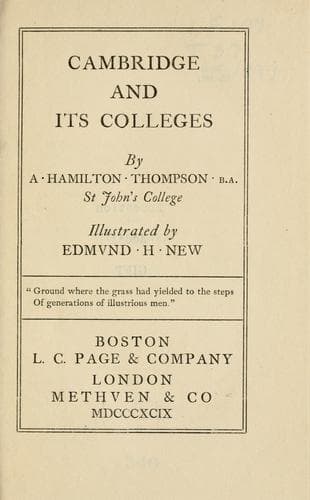
Cambridge and Its CollegesThompson, A. Hamilton (Alexander Hamilton)
History
Cambridge and Its Colleges
Thompson, A. Hamilton (Alexander Hamilton)
University of Cambridge
Thomas Baker,* the historian of St John’s College, deserves honourable
mention. The treasure which Oxford possesses in Anthony Wood, St John’s
finds in Baker, whose accurate history, quaintly and piously written,
is a mine of information on the subject of Cambridge life during the
seventeenth century. Baker was a Royalist of considerable bias and
a non-juror, in consequence of which he lost his fellowship. He was
careful to describe himself on his title-page as _Socius Ejectus_, and
gloried in the distinction. He died in 1740 at the age of eighty-four.
His devotion to his college, not only to the foundation itself, but
to its remotest benefactors, is a quality unique even in those days
of fidelity to a principle. He set the college an example by which it
has profited. To-day no college in Cambridge is in possession of such
an amount of printed historical matter. Professor Mayor’s monumental
edition of Baker and of the life of Ambrose Bonwicke stand at the head
of the list. Mr Torry’s extremely full and interesting notes on the roll
of Founders and Benefactors are invaluable, while Mr Scott’s “Notes
from the College Records,” which are published from time to time in the
college magazine, form a supplement and commentary to Baker’s history.
Ambrose Bonwicke, whose life is at once an exhortation to the painful
student and a faithful picture of social life at Cambridge, entered St
John’s in 1710, the last year of the mastership of Turner’s successor,
Humphrey Gower. Bonwicke died early, so that the story of his labours
and exertions, phenomenal in a mere boy and impossible in our own age,
has a vivid pathos. From the light which he throws upon college life of
his time, we are led to imagine that, however luxurious it may have been
then, it would now be insupportable, if conducted in the same way. But
then the prime object of university life was study, and athletics and
dinner-parties were considered foreign to the main purpose.
Public-domain text, read in full here on John Shaqi.
Reviews
Reviews
No reviews yet
Be the first to share your thoughts on this work.
Elsewhere in the archive
Join the Discussion
Join the discussion
Sign in to leave a comment or review.
Sign InorCreate an account