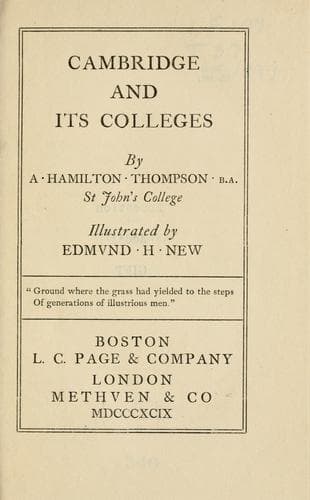
Cambridge and Its CollegesThompson, A. Hamilton (Alexander Hamilton)
History
Cambridge and Its Colleges
Thompson, A. Hamilton (Alexander Hamilton)
University of Cambridge
The accession of noble families to the college and the consequent growth
of court influence probably weaned the foundation from its Puritanism.
Dr Whitaker* was the last of the Genevan School. He was a married man,
and kept up an establishment for his wife in the town. The college
prospered exceedingly in his time. These were the days of Dr Nevile
of Trinity, when Cambridge received her most beautiful buildings.
Whitaker’s successor, Dr Richard Clayton, who ruled from 1595 to 1612,
had the felicity of seeing the second court built under his auspices.
Among the fellows at this time were Richard Neile,* and Thomas Morton,*
who, as Archbishop of York and Bishop of Durham, were great benefactors
to the college. And, with the reign of James I., the college began
to distinguish itself, like St John the Baptist’s College at Oxford,
as a Royalist institution. Thomas Wentworth, Earl of Strafford,* the
great Lord Lieutenant of Ireland, and Lucius Cary, Viscount Falkland,*
the blameless hero of the Cavalier party, are the celebrities of the
first half of the seventeenth century. In William Beale,* master from
1633 to 1644, the King had an enthusiastic supporter. In his time the
college plate was melted down, and many valuable pieces were sacrificed.
The plate was sent across country to Charles, who was then at York or
Nottingham, and the passage was so well contrived that the convoy escaped
the ambush set by Oliver Cromwell. Dr Beale was less happy, for Cromwell,
in a fury, marched upon Cambridge, and took him prisoner while he was at
his prayers in chapel. In company with Dr Martin of Queens’ and Dr Sterne
of Jesus, he was taken off to London and imprisoned in the Tower. He died
in 1646. During the Commonwealth, the college was ruled by Dr Arrowsmith
and Dr Tuckney, but at the Restoration the famous divine, Dr Peter
Gunning,* became master, having been previously Master of Corpus. He was
made Bishop of Ely in 1670, when he was succeeded by Francis Turner.* In
course of time, Turner succeeded Gunning at Ely. With these prelates we
may couple the name of Edward Stillingfleet,* the well-known Bishop of
Worcester.
Public-domain text, read in full here on John Shaqi.
Reviews
Reviews
No reviews yet
Be the first to share your thoughts on this work.
Elsewhere in the archive
Join the Discussion
Join the discussion
Sign in to leave a comment or review.
Sign InorCreate an account