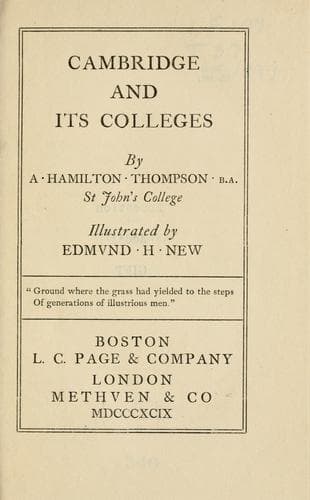
Cambridge and Its CollegesThompson, A. Hamilton (Alexander Hamilton)
History
Cambridge and Its Colleges
Thompson, A. Hamilton (Alexander Hamilton)
University of Cambridge
Since the arrest of Dr Beale, St John’s has enjoyed a very quiet
history. In the eighteenth century, it produced the regulation number
of noblemen and paid its full contribution to the cabinets of the
period. Towards the end of the century, we remark the name of the
eccentric Samuel Parr, whose portrait hangs in the Combination Room,
and of Herbert Marsh (* Ponsford), the controversialist and Bishop of
Peterborough, to whom Professor Mayor has devoted a large space in his
edition of Baker’s History. At the same time, we notice with interest
that William Wilberforce (* G. Richmond) and Thomas Clarkson (* Room)
were at St John’s together, and, while there, doubtless cultivated
the humanitarianism which is their common title to fame. Clarkson was
a native of Cambridgeshire, having been born at Wisbech, where his
father was master of the Grammar School, in 1760. But, in 1787, St
John’s received her most distinguished poet, William Wordsworth (*
Pickersgill). He himself, in lines which are at once oddly prosaic and
incomparably sublime, has described his impressions during his residence
at Cambridge. These, however, are the sole tie which binds him to the
place; for his retiring nature led him very little into society, and
his emotions and impressions were all highly subjective. He has told us
where his rooms were, but, owing to constant alterations, their exact
position has been somewhat disputed. They are at present turned into
one of the kitchen store-rooms. Some people, by a curious misreading of
the text, have imagined that he could look into Trinity antechapel from
his rooms and see Newton’s statue. As a matter of fact, he merely says
that he could see the antechapel, and this feat is easily performed from
any back-window on the south side of the first court. Like most highly
imaginative poets, and unlike the materialistic Matthew Prior, Wordsworth
was a dilatory student, and he deserted Cambridge in 1791 for the wilder
excitement of the French Revolution.
Public-domain text, read in full here on John Shaqi.
Reviews
Reviews
No reviews yet
Be the first to share your thoughts on this work.
Elsewhere in the archive
Join the Discussion
Join the discussion
Sign in to leave a comment or review.
Sign InorCreate an account