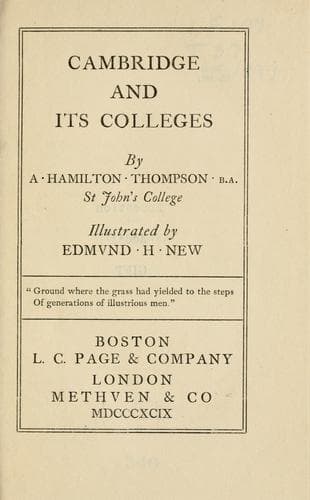
Cambridge and Its CollegesThompson, A. Hamilton (Alexander Hamilton)
History
Cambridge and Its Colleges
Thompson, A. Hamilton (Alexander Hamilton)
University of Cambridge
It is probable that no one has derived so much earthly benefit from an
early death as Henry Kirke White, who entered the college in 1804, died
in 1806, and has ever since been reckoned as one of its chief ornaments.
He is also the only member of the University who has a public monument in
Cambridge. At the age of nineteen he was a very promising mathematician,
and was patronised by Southey as a rising poet. The small collection of
poems and letters which constitute his “remains” show great religious
fervour and some metrical skill, but their imagination is defective and
morbid. His death excited great compassion, and his name still lives,
in England and America, as that of a precocious genius. It is not
unlikely that the greater name of Henry Martyn* is less widely known.
This distinguished scholar and Orientalist became a fellow in 1802, but
left Cambridge three years later to become a missionary. His life, short
although it is, is a splendid record of devoted piety and self-denial. He
went through dangers and privations in parts of the East which were then
totally unknown to Europeans, and died in the prosecution of his labours.
He may be regarded as the forerunner of a great band of Cambridge
missionaries, the earliest name in a kalendar which includes Ragland,
Mackenzie, Patteson and Smythies.
During the Napoleonic wars, Cambridge was possessed with a great martial
ardour, and among the most active promoters of the volunteer movement
of those days was Lord Temple,* who occupied rooms in the first court,
looking out on the street. Later on, this nobleman was better known as
Lord Palmerston. One of those who enrolled themselves under his guidance
was that eccentric gentleman, Patrick Brontë, subsequently Vicar of
Haworth in Yorkshire and father of a family whose tragic history is
well known to every student of English literature. With the name of
Palmerston, we touch modern times and come to the days of the scientific
and mathematical pre-eminence of the college. An extraordinary number
of great men have come from St John’s during the present reign. Among
scholars, Benjamin Hall Kennedy (* Ouless) has the first place. He
was, before his election to the Greek professorship, Head Master of
Shrewsbury, a school which has always been closely connected with St
John’s. The most distinguished historian was the late Charles Merivale,
Dean of Ely, whose _History of the Romans under the Empire_ is a monument
of Cambridge scholarship. The names of scientists are legion, but one
must not fail to mention John Couch Adams,* who was a Johnian and a
fellow of the college. The late James Joseph Sylvester (* Emslie),
although his genius was devoted to Oxford, is another man of world-wide
fame whom St John’s owns. The college supplied another distinguished
professor to Oxford in the person of Charles Pritchard, the well-known
Savilian professor. It is also necessary to mention the name of Edward
Public-domain text, read in full here on John Shaqi.
Reviews
Reviews
No reviews yet
Be the first to share your thoughts on this work.
Elsewhere in the archive
Join the Discussion
Join the discussion
Sign in to leave a comment or review.
Sign InorCreate an account