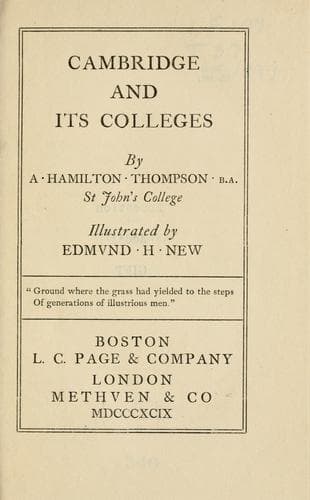
Cambridge and Its CollegesThompson, A. Hamilton (Alexander Hamilton)
History
Cambridge and Its Colleges
Thompson, A. Hamilton (Alexander Hamilton)
University of Cambridge
We have seen that Jesus and St John’s Colleges were founded by means
of the dissolution of monastic houses. Magdalene, founded thirty-one
years after St John’s, was merely the final step in the secularisation
of a religious house. In 1428 Henry VI. granted the site of the present
college to the monks of Crowland, who wished to found a hostel at
Cambridge for the use of their scholars at that University. The Abbeys of
Ely, Ramsey and Walden joined with Crowland in the work, and contributed
to the building. In the latter half of the century this theological
college, as we should call it, received substantial aid from Henry
Stafford, Duke of Buckingham, whose favours were continued in 1519 by
his son Edward. In recognition of the benefactions of Duke Henry, the
hostel took its title of Buckingham College. The foundation seems to have
departed gradually from its original purpose, for laymen were admitted
to it before the dissolution. However, it was only natural that, when
Crowland surrendered to the King, its dependent house should surrender
also. The crown resumed the property in December, 1539. Henry VIII.
granted the messuages of Buckingham College to Thomas, Lord Audley of
Walden, who also became possessed of Walden Abbey. In all probability,
the original connection between the abbey and the college induced him to
refound the institution on a new plan. He reconstituted it in 1542 under
the name of the College of St Mary Magdalene. Since his day, through all
the vicissitudes of his family, Magdalene College has remained under
the protection and patronage of the owner of Audley End, a stately and
beautiful appendage to the noblest country house in England. His work
was carried on by his successors. At his death he left a daughter, the
lady whose magnificent portrait by Lucas van Heere hangs in the great
hall at Audley End. She married the Duke of Norfolk, who, in 1564, being
at Cambridge with Queen Elizabeth, generously promised the college an
annuity of £40 until they had finished the “quadrant of their college,”
and further endowed the society, which was become much impoverished,
with landed property. Norfolk’s liberality was supplemented by the
contributions of the Lord Chief Justice Sir Christopher Wray,* who had
been one of the lay students of Buckingham College.
Public-domain text, read in full here on John Shaqi.
Reviews
Reviews
No reviews yet
Be the first to share your thoughts on this work.
Elsewhere in the archive
Join the Discussion
Join the discussion
Sign in to leave a comment or review.
Sign InorCreate an account