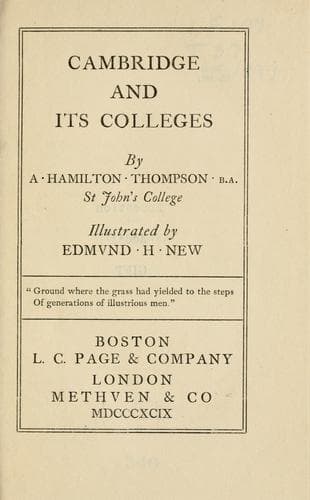
Cambridge and Its CollegesThompson, A. Hamilton (Alexander Hamilton)
History
Cambridge and Its Colleges
Thompson, A. Hamilton (Alexander Hamilton)
University of Cambridge
The college was never large, and its history is scanty. Its first master
of any importance was Dr Thomas Nevile, who reigned from 1582 to 1593,
and then removed to Trinity. His fame belongs to the history of the
latter college. In the great concussion of the seventeenth century,
Magdalene adhered, as was natural, to the royalist side, and its master,
Dr Rainbow,* was rewarded after the Restoration with the Bishoprick
of Carlisle. Nicholas Ferrar,* the famous superior of the community at
Little Gidding, and the friend of Crashaw and Herbert, was a member
of this college as well as of Clare, and his portrait, with that of
his mother, is preserved in the Master’s Lodge. This saintly man, like
Herbert, was happy in dying before the troubles of his party began. But
one naturally connects Magdalene less with Ferrar than with an individual
of a very different order. Mr Samuel Pepys was entered at Trinity in
1650, but, for some reason, preferred Magdalene. By no means a scholar,
he enjoyed the social advantages of the University, and in after years
remembered the grateful flavour of Goody Mulliner’s stewed prunes, which
he used to buy “over against the college.” His eventual generosity to
Magdalene was something of an accident. During the closing years of his
life, the college was raising the exquisite eastern building. Pepys was
then casting about for a suitable destination for his library, and there
is no doubt that the singularly admirable qualities of the new building,
as well as his own prepossession for Magdalene, aided his decision. By
his will, he bequeathed his library to his nephew, Mr Jackson (another
Magdalene man), as his trustee, and provided that, at the death of this
gentleman, it should pass to Magdalene, and, by an express stipulation,
be housed in the New Building “and any part thereof, at my nephew’s
selection.” The document contained certain reservations in favour of
Trinity. Its whole wording shows an amusing caution. After a preamble,
in which he expresses his apprehension of the danger which might befall
the books at the hands of an incompetent heir, he proceeds to leave them,
at his nephew’s death, to one of the two Universities, but to Cambridge
rather than to Oxford. Then he states his preference for a private to
a public library, and confines the private libraries to Trinity and
Magdalene. Finally, he prefers Magdalene to Trinity, but provides that,
in case of specified losses, the books are forfeit to the latter college.
In this respect, he imitates Parker’s bequest to Corpus. “And that for a
yet further security herein, the sᵈ two colleges of Trinity and Magdalen
have a reciprocall check upon one another; and that college, wᶜʰ shall
be in present possession of the sᵈ Library, be subject to an annual
visitation from the other, and to the forfeiture thereof, to the like
possession and use of the other, upon conviction of any breach of their
sᵈ covenants.”
Public-domain text, read in full here on John Shaqi.
Reviews
Reviews
No reviews yet
Be the first to share your thoughts on this work.
Elsewhere in the archive
Join the Discussion
Join the discussion
Sign in to leave a comment or review.
Sign InorCreate an account