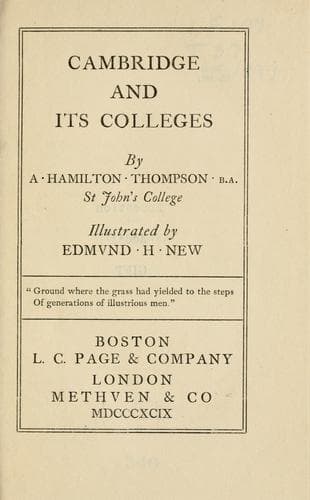
Cambridge and Its CollegesThompson, A. Hamilton (Alexander Hamilton)
History
Cambridge and Its Colleges
Thompson, A. Hamilton (Alexander Hamilton)
University of Cambridge
Not long after King’s Hall had received its new eastern gateway, which
implies a considerable extension of the college, Henry VIII. dissolved
the lesser foundations and founded Trinity as we know it. Henry’s chief
wish was to provide a sufficient chapel. It was not, however, until
Mary’s reign that any activity was shown in this work. Mary furthered
her father’s project, and allowed the builders to use the ruins of
Cambridge Castle as their quarry. The work was finished by Elizabeth.
Trinity Chapel is an excellent example of late Perpendicular work. As
Gothic work, it is stiff and debased, and forms a striking contrast to
the elegance of the Renaissance Hall. Its exterior has been very little
altered. Internally, however, it belongs to a much later period. The
west window was filled up by Nevile; the east window is obscured by a
huge baldachino of the last century. During Bentley’s mastership, Father
Smith built the present organ, one of the largest in England; and the
whole chapel was refitted to suit the capacities of this instrument.
Opinions may differ about the beauty of the heavy wooden screen in an
uncompromisingly classical taste which supports the organ and divides the
chapel from the antechapel; but it is unquestionably a very appropriate
addition to a stately, if ugly, interior. The carving of the stalls is
by Grinling Gibbons. Alterations did not stop here. The present century
has made the building what it is. Within the last thirty years the roof
and walls have been highly decorated in accordance with the rest of the
chapel, and the result is very imposing. Mr Henry Holiday’s stained
glass, which represents the saints and worthies of the Church from the
earliest period, is good, although its merits are a little various. The
western windows near the organ, devoted to members of Trinity, are the
best. In the antechapel the glass is very bad indeed. Otherwise, this
part of the building is not much altered, and its panelling of dark oak
makes it one of the most impressive sights in either university. This
is much increased by the fine statues. Of these, that of Newton, by
Roubiliac, was given in 1755 by the master, Dr Smith. The rest are more
modern. Bacon’s statue, by Weekes, was given by Dr Whewell; Barrow’s by
the late Lord Lansdowne. The statues of Macaulay and Whewell are both by
Woolner.
Public-domain text, read in full here on John Shaqi.
Reviews
Reviews
No reviews yet
Be the first to share your thoughts on this work.
Elsewhere in the archive
Join the Discussion
Join the discussion
Sign in to leave a comment or review.
Sign InorCreate an account