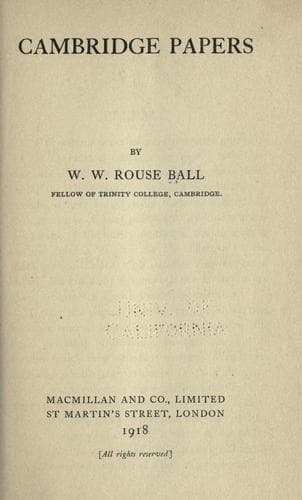
Cambridge PapersBall, W. W. Rouse (Walter William Rouse)
History
Cambridge Papers
Ball, W. W. Rouse (Walter William Rouse)
Trinity College (University of Cambridge); University of Cambridge -- History
The colleges were intended for picked scholars. In the course of the
fourteenth century the problem of the care of other students was taken
up, and they were forbidden to live in lodgings selected by themselves
and under no external supervision. To provide for them, the University
licensed private hostels which were managed by masters of arts on
lines somewhat similar to boarding houses in public schools to-day.
Thenceforth throughout the middle ages the majority of undergraduates
resided in these hostels. Caius gave the names and sites of
twenty-seven private hostels which he had known and all of which
closed their doors during his life, the last in 1540: Fuller
enumerated thirty-four hostels and two "inns" while his editor
mentioned fourteen other hostels, but some of these certainly ought
not to be included under the term. Perhaps we may say that the number
open at anyone time rarely exceeded thirty or fell short of twenty:
some were cheap, some expensive; some were well managed, others not
so. After the development of these hostels the guilds decreased in
importance, and finally disappeared.
With the establishment of colleges and private hostels the University
was fairly launched on its career in a form which lasted till the
middle half of the sixteenth century. My object was to state how, in
my opinion, it originally took shape, and I do not propose here to
follow its history further.
[Footnote 31: Most of the known facts are given in Mullinger's
excellent histories, Peacock's _Observations on the Statutes_, and
Rashdall's _Universities of Europe in the Middle Ages_--but all the
views of the last-named writer are not universally accepted.]
[Footnote 32: See _passim_ G. Peacock, _Observations on the Statutes_,
London, 1841, p. xxxv.]
CHAPTER XII.
DISCIPLINE.
This paper contains some extracts from my notebooks on the way in
which university and college discipline was maintained in former days
at Cambridge. The records on the subject are scanty, but I think the
facts are worth putting together in a connected form. There is no
reason to suppose that the practices of different colleges varied
materially, and if in the later period I have taken examples from the
records of Trinity it is only because I have had easier access to
them.
In the history of university discipline and social customs abrupt
changes are not to be expected, and none such are noticeable in the
transition from the medieval period, _circ._ 1200 to 1525, through
the renaissance, _circ._ 1525 to 1640, and the period of stagnation,
_circ._ 1660 to 1820, to the present age of reconstruction and
extension. I begin naturally with discipline in medieval Cambridge.
Public-domain text, read in full here on John Shaqi.
Reviews
Reviews
No reviews yet
Be the first to share your thoughts on this work.
Elsewhere in the archive
Join the Discussion
Join the discussion
Sign in to leave a comment or review.
Sign InorCreate an account