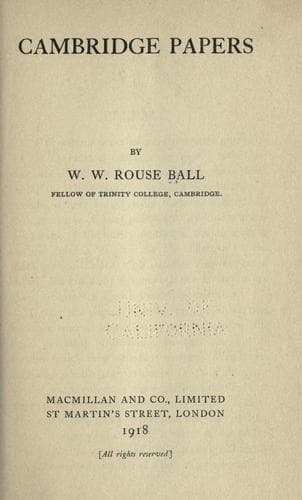
Cambridge PapersBall, W. W. Rouse (Walter William Rouse)
History
Cambridge Papers
Ball, W. W. Rouse (Walter William Rouse)
Trinity College (University of Cambridge); University of Cambridge -- History
In the early days of the University the students lodged in the town
and were of all ages from twelve or thirteen upwards. Except in
strictly academic matters, there was little or no supervision of their
conduct, and, outside the schools, grave disorders were common; the
University, however, claimed power, when it chose, to take cognizance
of all offences contrary to good manners, and at any rate in later
days did so in serious cases. The regulations at Cambridge and Oxford
were so similar that we may fairly draw illustrations from either
University, and the records of the chancellor's court at Oxford in the
fifteenth century show that fines, imprisonment, and, in extreme
cases, expulsion were customary penalties for serious offences against
university regulations and customs. I have no doubt that earlier
records, if extant, would be of the same general character.
The first college to be founded at Cambridge was Peterhouse which took
its final form in 1284, and during the next century several other
similar Houses were established: these societies were intended for
selected scholars. The problem of the control of other students was
met in the course of the fourteenth century by preventing them from
living in private lodgings chosen by themselves, and thenceforth,
throughout the middle ages, those who came from a distance were
generally required to reside in private hostels run by masters of arts
on lines somewhat similar to boarding houses in public schools to-day.
Besides the lay and secular students accommodated in colleges, private
hostels, and at their homes, there were also in the medieval
University a considerable number of "religious" students who were
housed in monasteries or monastic hostels. Some of the colleges in
later medieval times received as paying members a few wealthy
pensioners, parochial priests in middle life, and even monks from
distant convents, but probably the number of such favoured students
was never large. With the establishment of colleges and the
organization of private hostels discipline improved; inside their
walls as well as in the monastic hostels it is probable that order was
well maintained, but outside them, at least among the students at
private hostels, discipline was left to the university authorities who
did little or nothing in the matter.
Public-domain text, read in full here on John Shaqi.
Reviews
Reviews
No reviews yet
Be the first to share your thoughts on this work.
Elsewhere in the archive
Join the Discussion
Join the discussion
Sign in to leave a comment or review.
Sign InorCreate an account