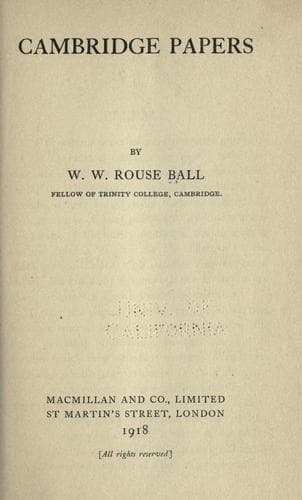
Cambridge PapersBall, W. W. Rouse (Walter William Rouse)
History
Cambridge Papers
Ball, W. W. Rouse (Walter William Rouse)
Trinity College (University of Cambridge); University of Cambridge -- History
Membership of a college was a privilege confined, in general, to
scholars specially nominated, and no doubt the standards of work and
discipline there were higher than in the private hostels. Naturally we
know less of life in these hostels, but it is likely that disciplinary
rules were originally made by or with the approval of the elder
residents, and that the normal discipline in them was of the same
general character as that exercised in colleges, though, as the
members paid for themselves, money fines were possible and usual
penalties, especially in the case of the older members. There must
have been more variety in the discipline of hostels than of colleges,
and we may safely say that some hostels were well conducted, others
not so.
It is possible that finally the University claimed the right to
examine and supervise the internal regulations of the hostels. A set
of rules, thus enforced on an unendowed hall at Oxford in the
fifteenth century, has been discovered and printed by Rashdall: they
do not differ much from those usual at a college, except that some of
the penalties specified are pecuniary, and that the principal was
given explicit permission, if he wished, to flog a student, even
though the lad's own master (_i.e._ the master to whom he had been
apprenticed) had certified that he had already corrected him or was
willing to do so.
Was corporal punishment commonly used in medieval times? Until
recently it was accepted without argument that this was the case; and
certainly in the fifteenth century and later when we get detailed
information on the subject, the younger students were subject to it.
Rashdall, however, has argued that the absence of its mention in
earlier times implies that the birch was unknown in the ordinary
university regulations till towards the end of the sixteenth century
or later, though he admits in various places that glomerels were
liable to it: his authority is accepted by Rait. It is true that in
the statutes given in the thirteenth and fourteenth centuries,
birching is not mentioned explicitly, but, since the punishments for
petty offences are rarely specified in detail, this proves nothing. In
the fifteenth century corporal punishment is mentioned as a recognized
penalty. For instance, the statutes given by Henry VI to King's
College, Cambridge, prescribed that scholars and young fellows might
be punished by stripes, and a year or two later, the statutes of
Magdalen College, Oxford, directed that the demies should be subject
to flogging. In later regulations of various colleges, to some of
which I refer below, whipping is mentioned as a recognized punishment,
but often as one to which only the younger students were liable.
Public-domain text, read in full here on John Shaqi.
Reviews
Reviews
No reviews yet
Be the first to share your thoughts on this work.
Elsewhere in the archive
Join the Discussion
Join the discussion
Sign in to leave a comment or review.
Sign InorCreate an account