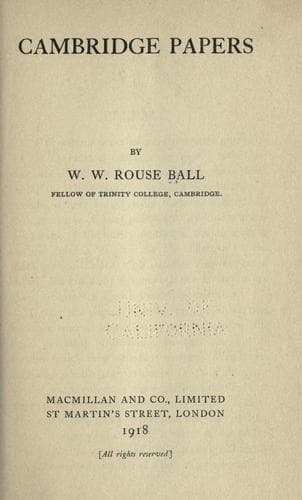
Cambridge PapersBall, W. W. Rouse (Walter William Rouse)
History
Cambridge Papers
Ball, W. W. Rouse (Walter William Rouse)
Trinity College (University of Cambridge); University of Cambridge -- History
The colleges took seriously their responsibilities for discipline, and
all things contrary to good manners and morals were prohibited. For
the gravest offences, such as contumacy, crimes of violence, and
heresy, expulsion was usually ordered. Among less serious
delinquencies, explicitly forbidden and therefore we may assume not
unknown, were bringing strangers into the house, sleeping out, and
absence without leave; using insulting language, drunkenness,
gambling, and frequenting taverns; keeping company with loose women;
throwing missiles and carrying arms; and the keeping of dogs, hawks,
falcons, and ferrets. In the regulations of many colleges, a course
of study was indicated, and directions given that idleness was to be
punished. Regular attendance at religious exercises was assumed, and
was explicitly directed on certain occasions: I suppose that students
performed such duties without much external pressure, and I know no
record of the infliction of any penalty in early times for
non-attendance. In the middle ages Latin was the language generally
enforced, though occasionally French was permitted; this remained the
rule until the seventeenth century. Conversation during dinner and
supper was forbidden in many colleges, and of course was impossible in
those cases where some book was then read aloud. At King's College,
jumping and ball throwing, and at Clare College meetings in bedrooms
for feasting and talking were also forbidden. At a somewhat later date
Caius ordered his students to be in bed by eight o'clock at night, but
they made up for this by rising very early in the morning. In general
the punishment for minor faults was left to the discretion of the
authorities. This was only reasonable, for a medieval college was a
mixed community of lads and men, the members being of all ages from
about fourteen or fifteen upwards; and rules enforced on boys of
fourteen could not be applied to men of twenty-three or twenty-four,
who were in fact already taking part in the teaching of the junior
scholars.
For all members, the ultimate penalty for the gravest offences was
expulsion. For less serious misconduct, fines, restrictions on the
food supplied, impositions, and confinement within the walls, are
believed to have been common penalties, at any rate for adolescents;
but, as I explain below, I think that corporal punishment was
constantly inflicted on non-adults in lieu of a fine, which indeed
boys would have had considerable difficulty in paying. As far as the
younger students and the bachelors at colleges were concerned the
extant regulations in regard to their exercises, amusements, incomings
and outgoings, suggest that they were treated much like the junior and
senior boys in a rather strict public school in the first half of the
nineteenth century; and perhaps the senior graduate members were
treated somewhat like residents in colleges at the same period.
Public-domain text, read in full here on John Shaqi.
Reviews
Reviews
No reviews yet
Be the first to share your thoughts on this work.
Elsewhere in the archive
Join the Discussion
Join the discussion
Sign in to leave a comment or review.
Sign InorCreate an account