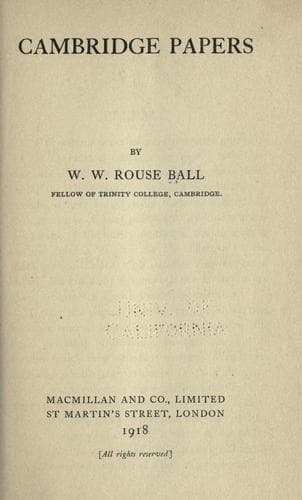
Cambridge PapersBall, W. W. Rouse (Walter William Rouse)
History
Cambridge Papers
Ball, W. W. Rouse (Walter William Rouse)
Trinity College (University of Cambridge); University of Cambridge -- History
In more recent times the deeds of Busby and Keate at Westminster and
Eton respectively are preserved in tradition, while the reputation of
Udall at an earlier time, _circ._ 1530, may be gathered from the
remarks of Thomas Tusser, a choirboy at St Paul's Cathedral, who
subsequently went to Eton: Tusser says, "From Paul's I went, to Eton
sent, To learn straightways the Latin phrase Where fifty-three stripes
giv'n to me, at once I had. For faults but small, or none at all, It
came to pass thus beat I was." The similar vigour of Udall's
successor, Cox, is mentioned by Ascham. In short, the old saw: "Spare
the rod, and spoil the child, Solomon said in accents mild, Be it boy
or be it maid, Whip 'em and wallop 'em Solomon said" represented the
current belief and practice of former days; though the dictum
attributed to that king is stronger than the passage in Proverbs,
xiii, 24 warrants.
In the sixteenth century the colleges opened their doors to the
admission of pensioners and fellow-commoners. Collegiate teaching and
arrangements were superior to those of the private hostels, and before
the middle of the century the latter had disappeared: their revival
was rendered impossible by a regulation that membership of the
University should be confined to those who were members of a college.
Shortly afterwards it became the custom not to require residence for
degrees after the baccalaureate, and thus a course limited to three or
four years became usual for the average student. These changes were of
far-reaching importance.
In the course of this century new statutes were given to the
University and colleges, and subsequently we possess records, fairly
complete, of the domestic life of students. Early in the following
century, the average age of entry began to rise, and before its close,
it had become common for students to defer entry until about seventeen
years old.
University decrees regulating the conduct of students in many matters
now appear, notably one in 1595 by Goad, then vice-chancellor, which
gives a summary of what was expected. Expulsion, suspension from
degrees, and refusal of leave to graduate until after a specified
time, were normal punishments for serious offences, for trivial
misconduct fines are now constantly prescribed, and physical
punishments for non-adults are also directed in many cases.
Public-domain text, read in full here on John Shaqi.
Reviews
Reviews
No reviews yet
Be the first to share your thoughts on this work.
Elsewhere in the archive
Join the Discussion
Join the discussion
Sign in to leave a comment or review.
Sign InorCreate an account