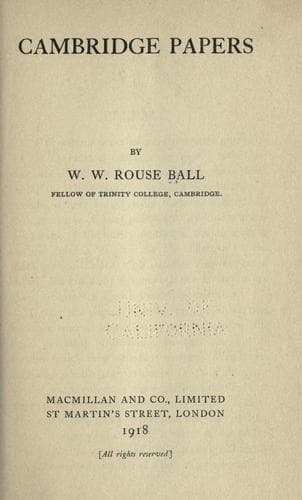
Cambridge PapersBall, W. W. Rouse (Walter William Rouse)
History
Cambridge Papers
Ball, W. W. Rouse (Walter William Rouse)
Trinity College (University of Cambridge); University of Cambridge -- History
In colleges, the Tudor statutes generally enjoined good conduct on all
students. The regulations about the punishment of offences were mostly
concerned with grave matters for which admonitions, and finally
expulsions, were the recognized punishments. Penalties for the
non-performance of religious exercises now appear: thus, at Christ's
College, Cambridge, and at Balliol College, Oxford, whipping was
prescribed as a penalty for absence from chapel, though probably
restricted to the younger students; so too at Peterhouse, students
over eighteen who were absent from prayers were to be fined, while
younger students so offending were to be deprived of dinner, and if
persistent in their neglect flogged in hall.
As in medieval times, the authorities were generally left a free hand
in settling the regulations for the maintenance of normal discipline.
Probably fines, impositions, restrictions on the food supplied, and
gatings continued to be ordinarily used. Reading the bible aloud at
meal times in hall, dining apart on bread and water, and being
deprived of commons, are definitely mentioned in the 1520 statutes of
St John's College, Cambridge, as possible penalties; similarly at
Corpus Christi College, Oxford, being compelled to eat alone at a
small table in the middle of the hall and restriction to bread and
water are specified as suitable punishments.
The use of the birch was now constantly prescribed, though probably
in practice always confined to lads. Thus, at Christ's College,
Cambridge, a whipping for lads and a fine for adults; and at
Brasenose, Oxford, a fine or a flogging, at the discretion of the
principal, were statutable punishments for various faults, including
at the latter College the making of odious comparisons in
conversation. At other Houses too, for instance, at Corpus Christi,
Oxford, Wolsey (Christ Church), Oxford, Trinity College, Cambridge,
and Gonville and Caius, Cambridge, the use of the cane or birch is
sanctioned in the case of lads. I have no doubt this was also the
general rule in earlier days, and nothing in the Tudor codes indicates
that any material change was made in the existing practice, but on the
whole I conjecture that the regulations were more humane, and I am
inclined to think, contrary to Rashdall's view, that discipline was
less severe after the renaissance than before it. In colleges the
deans were and are the chief officers responsible for discipline; in
the University, the proctors.
A part of the fifth chapter of the Trinity statutes of 1560 relating
to the office of deans may be summarized as indicating what was then
customary, or at any rate desired, in the matter of chapel attendance
and in certain questions of petty discipline. The statute, which is in
Latin, is to the following effect:
Public-domain text, read in full here on John Shaqi.
Reviews
Reviews
No reviews yet
Be the first to share your thoughts on this work.
Elsewhere in the archive
Join the Discussion
Join the discussion
Sign in to leave a comment or review.
Sign InorCreate an account