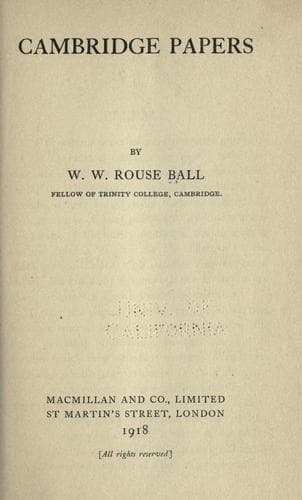
Cambridge PapersBall, W. W. Rouse (Walter William Rouse)
History
Cambridge Papers
Ball, W. W. Rouse (Walter William Rouse)
Trinity College (University of Cambridge); University of Cambridge -- History
Thirty years later, after the disturbances of 20 February 1607,
following the performance of a comedy in King's College, an order was
issued that thereafter every ringleader in any similar disturbances
should be banished from the University: and every less responsible
offender should, if a graduate, pay for the harm done, be suspended
from his degree, and for one year refused leave to take a further
degree; and if a non-graduate should for one year be refused leave to
graduate, and further, if non-adult, be corrected in the schools by
the rod, and, if adult, make an open confession of his guilt in the
schools: also the offender if not a scholar should be set in the
stocks at the bull ring in the market place. Here, it will be noticed,
the punishment by the rod is restricted to those non-adulti.
In a list of punishments inflicted at Corpus Christi College in 1622,
quoted by Lamb, admonitions, fines, suspensions, and whippings are
mentioned. Even as late as 1648 there is a record of "Benton per
Tutorem suum Magistrum Johnson virgis castigandis."
In 1648 an undergraduate bible-clerk of Peterhouse, age about
seventeen, Tobias Conyers by name was "corrected publicly"--which,
I take it, means flogged--for toasting the king. But times were
abnormal, and if Conyers ventured into the stirring field of politics,
he had to take the consequences.
The liability to a flogging still existed after the restoration.
Thus in the _Poor Scholar_, by R. Nevile, London, 1662, there are
references to it in Act ii, Scene 6, and Act v, Scene 4, as being
still in use in colleges though whether adults were so liable is
uncertain. If the author's statements refer to contemporary matters
and are trustworthy it would seem that the punishment was then
common, the culprits being mounted on barrels, and the flogging
inflicted at the butteries. The birch was also still occasionally used
in university discipline, for on 20 March 1674, the vice-chancellor
ordered Ellethorpe of St John's, and Hodges of Sidney Sussex to be
whipped for having been rude to the junior proctor, Peter Parham, of
Caius College: neither of the offenders had matriculated.
These references provide the strongest evidence with which I am
acquainted for the assertions that flogging was a usual punishment at
Cambridge during the seventeenth century. There is a widely spread
tradition that when at Christ's College, Milton was flogged, but Peile
has shown that there is no satisfactory evidence for it, and it is
intrinsically improbable. In a disciplinary order of Corpus Christi
College in 1684, the only punishments mentioned are discommonsings,
admonitions, rustications, deprivation of seniority, and refusal of
college testimonials, so, comparing this with the orders of 1622 and
1648 which I have quoted above, perhaps we may take it that the use of
the rod there had become obsolete.
Public-domain text, read in full here on John Shaqi.
Reviews
Reviews
No reviews yet
Be the first to share your thoughts on this work.
Elsewhere in the archive
Join the Discussion
Join the discussion
Sign in to leave a comment or review.
Sign InorCreate an account