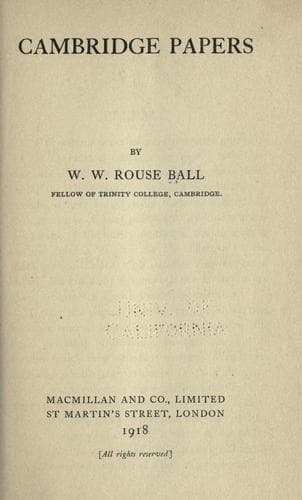
Cambridge PapersBall, W. W. Rouse (Walter William Rouse)
History
Cambridge Papers
Ball, W. W. Rouse (Walter William Rouse)
Trinity College (University of Cambridge); University of Cambridge -- History
_Loss of Days._ To qualify for a degree and for an emolument, it is
and has been generally necessary to keep a certain number of days by
residence in each of certain specified terms. At one time a common
form of punishment was to cancel a certain number of days already
kept. Thus the student would be obliged to stay at Cambridge for so
many additional days to make up for the requisite number which had to
be kept in the course of that term. In the seventeenth century the
authorities went further and sometimes cancelled terms that had been
kept. I believe this form of punishment has long been obsolete.
_Gating. Walling._ Continuous confinement within the walls of the
college (walling) or confinement during certain hours (gating) was
another form of punishment. A case of walling occurred at one of the
smaller colleges in Cambridge in 1872, but I know of no more recent
instance. Gating is still in force. It causes some social
inconvenience. As far as it goes, it promotes regular hours and
economy, and it has no indirect ill-effects. Accordingly it serves
well to mark dissatisfaction and act as a warning.
Here is an old-time example from the records of Trinity, 19 July 1652,
of the infliction of this and other penalties interesting from the
name of the scholar on whom it was inflicted:
Agreed that Dryden be put out of commons for a fortnight at least,
and that he goe not out of the colledg during the time aforesaid,
excepting to sermons, without express leave of the master or
vice-master; and that at the end of the fortnight he read a
confession of his crime, in the hall, at the dinner time; at the
three fellowes tables.
His offence was disobedience to the vice-master, and his contumacy in
submitting himself to discipline.
_Impositions._ Another tolerably obvious punishment was the setting of
impositions. The imposition might be the learning of lines by heart or
the delivery of a declamation on some given subject, or the production
in writing of so many lines of a classical work or of an analysis of
some book. Impositions in writing were constantly done vicariously,
and if so, the punishment was little more than a fine: apparently this
abuse of the practice was well known.
The tasks set were very heavy. In the _Gradus_, 1803, the learning by
heart of the first book of the _Iliad_ is mentioned as a possible,
though very severe imposition. Similarly, according to J.M.F. Wright,
a thousand lines of Homer would have been regarded in 1815 as an
unusually sharp punishment, but such as might have been given in lieu
of rustication. Other impositions mentioned are the learning by heart
of a satire of Juvenal, and the production of an analysis of Butler's
_Analogy_.
At Trinity the deans were provided with long sheets of paper on which
were printed in double columns forms such as the following:
Public-domain text, read in full here on John Shaqi.
Reviews
Reviews
No reviews yet
Be the first to share your thoughts on this work.
Elsewhere in the archive