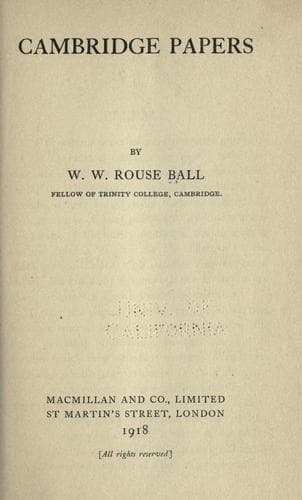
Cambridge PapersBall, W. W. Rouse (Walter William Rouse)
History
Cambridge Papers
Ball, W. W. Rouse (Walter William Rouse)
Trinity College (University of Cambridge); University of Cambridge -- History
_Fines._ Pecuniary fines have been used to enforce discipline from
the earliest times by the University as well as by the colleges: after
the renaissance, the increasing age and means of students made fines a
suitable penalty for many of the less serious offences, such as
participation in forbidden amusements, visits to places out of bounds,
walking across the grass in college courts, smoking in public places,
the failure to wear academic dress when required, non-attendance at
lectures, chapel, hall, etc. Probably grave misconduct was punished
otherwise, or by fines combined with additional penalties. A fine, if
heavy, presses unequally on men of different means; and thus a system
of fines on a fixed scale cannot be regarded as equitable. Fines are
still used as penalties for the infraction of rules.
_Discommonsing. Dissizaring._ To be put out of commons was a
well-recognized penalty, applicable chiefly to scholars and sizars,
part of whose emolument consisted of a right to dine in hall and, in
some cases, to have commons (bread, butter, and beer) to a limited
amount each day. To deprive such a student of the right to dine in
hall or of his commons was equivalent to a pecuniary fine, and in the
case of a poor scholar might be a severe, though not a satisfactory,
punishment; probably a modicum of bread and beer was supplied to
students even when discommonsed. In some comments, published in 1768,
on university education at Cambridge, discommonsing is described as
"one of the most idle and anile punishments ... inflicted rather on
the parent than on the young man, who being prohibited to eat in Hall
is driven to purchase a dinner at a tavern or coffee house."
Here is an example of an order of discommonsing at Trinity in the
seventeenth century: "Agreed that Cassill should be punisht a monthes
commons.... Agreed at the same time that Pepys besides a monthes
commons, should have an admonition and pay the charges of the
chirurgion for the healinge Cassil's head w^h he broke with a key."
(Conclusion, 1 August 1643.) Its preservation is due to the fact that
Pepys' punishment was combined with an admonition, and evidence that
an admonition had been given might be required if subsequently a
question of expulsion arose. The culprit in question was Thomas Pepys
(B.A. 1645) and not the Samuel of immortal memory.
In 1815, Mansel, master of Trinity and bishop of Bristol, was
accustomed to put men out of sizings and commons if they appeared in
hall in trousers instead of knee breeches, and it would seem then that
to be put out of sizings further deprived the student of obtaining
private supplies from the college kitchens. Half a century ago the
penalty was still in use at Trinity, being imposed on scholars in
waiting, who failed to appear after hall to say grace.
Public-domain text, read in full here on John Shaqi.
Reviews
Reviews
No reviews yet
Be the first to share your thoughts on this work.
Elsewhere in the archive
Join the Discussion
Join the discussion
Sign in to leave a comment or review.
Sign InorCreate an account