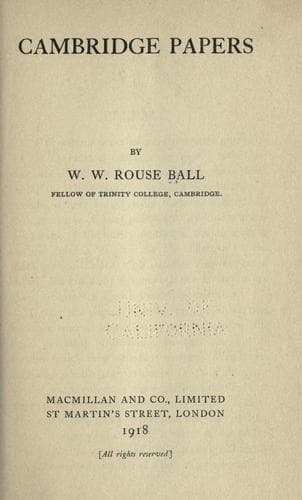
Cambridge PapersBall, W. W. Rouse (Walter William Rouse)
History
Cambridge Papers
Ball, W. W. Rouse (Walter William Rouse)
Trinity College (University of Cambridge); University of Cambridge -- History
A formal admonition was intended to act as a serious warning, and it
served as a statutory prelude to expulsion. For this reason it was
usually recorded, and in former times an additional sting was added by
compelling the culprit to make also a public or written confession of
his fault. Admonitions are not very common in the records of Trinity:
some thirty or forty occur in the sixteenth and seventeenth century,
only a few in the eighteenth century, and they are rare in the
nineteenth century save for a few relating to irregularity of
attendances at chapel or lectures. The last admonition at Trinity was
given in 1881, shortly before the new statutes of 1882 became
operative. Here are typical instances of the record of admonitions.
Whereas heretofore I have received an admonition from the Master of
the College for my lewd and outrageous behaviour within the same,
and have since that time for like rioting and swaggering in the Town
received another admonition from him before the Vice-Master of the
College and my Tutor and also therewith all public correction, if
these admonitions together with due punishment do not work
reformation in me hereafter, I do likewise willingly acknowledge
that I am incorrigible and worthy for the next like offence to be
expelled the College. Galen Browne. Circ. 1601. [Browne was elected
to a scholarship in 1602, and graduated B.A. and M.A. in due course,
so presumably he amended his ways.]
Whereas I have very unadvisedly and rashly stricken one Mr Halfhead,
a College servant, to the shedding of blood, I do acknowledge myself
to have received an admonition for that fault tending to expulsion.
Thomas Shirley, 22 February, 1621. [Halfhead was the manciple.
Shirley was a fellow and master of arts, so the offence was the more
serious, but perhaps the provocation was great. Shirley was
subsequently junior bursar and tutor.]
I, Christopher Offley, do confess that often time and many ways I
have offended against the Statute _de Modestia Morum_ to the
displeasure of God, hurt to myself, the evil example of others, and
discredit of the College, and also have broken mine oath taken when
I was preferred scholar in unreverent behaviour towards some of the
fellows and specially in giving scandalous and contumelious speeches
to Mr Hitch, being the Minister and Fellow of this College for which
misdemeanors and undutiful carriage I am unfainedly sorry and
heartily desire forgiveness both of God, and him, or any other whom
I have offended, and confess I have received a just admonition of
the Master and Seniors by setting my date to this writing. Circ.
1622. [Offley graduated B.A., 1624, and M.A., 1627, so presumably he
amended his ways.]
Public-domain text, read in full here on John Shaqi.
Reviews
Reviews
No reviews yet
Be the first to share your thoughts on this work.
Elsewhere in the archive
Join the Discussion
Join the discussion
Sign in to leave a comment or review.
Sign InorCreate an account