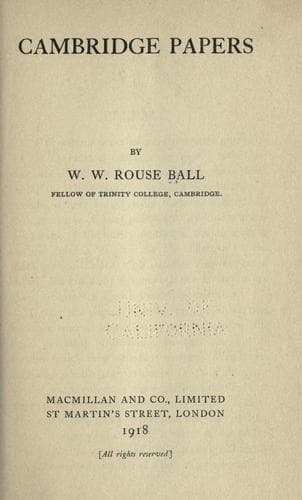
Cambridge PapersBall, W. W. Rouse (Walter William Rouse)
History
Cambridge Papers
Ball, W. W. Rouse (Walter William Rouse)
Trinity College (University of Cambridge); University of Cambridge -- History
Whereas we whose names are underwritten, on the fourth of April
last, were guilty of grave irregularity and misbehaviour by
insulting the Vice-Master, the Dean, and other officers of the
College and thereby gave just offence to the Society, we do profess
ourselves heartily sorry for the same and acknowledge the lenity of
the Master and Dean in suffering us to return so soon from
rustication. And we do hereby engage to be strictly observant of our
duty for the future and take this as our first admonition in order
to expulsion. James Bensley, John Ambler. 29 May, 1754. [Bensley
graduated in due course and was elected to a fellowship: Ambler did
not graduate.]
Ordered that ..., for irregular attendance at lectures and neglect
of impositions, be admonished a second time previous to rustication
or expulsion. 29 May, 1844.
Temporary or permanent removal from the College were penalties
reserved for the gravest offences. They are still recognized as
possible punishments. The fact that there are but few records of the
infliction of these extreme penalties indicates how easily discipline
has always been maintained.
My readers may well think that the results of these notes are somewhat
scanty, but if that nation is happy which has no history, surely
universities and colleges are to be congratulated whose records of
punishment are so few. To sum up the matter, the general effect left
on my mind is that most of the common offences were due only to
youthful exuberance of spirits and not to deliberate mischief making;
and that the rules and sanctions, judged by the standard of their
time, have been neither harsh nor unreasonable, and have usually been
approved by public opinion in the University.
CHAPTER XIII.
NEWTON'S _PRINCIPIA_.
Newton's _Principia_ is one of the few scientific books which has
sensibly affected the methods of scientific research and the ideas of
men about the universe. It is on this aspect of the subject I propose,
in this paper, to make a few remarks. The work itself is a classic in
the history of mathematics: the exposition of the subject, the
enunciation of the principle of prime and ultimate ratios, the
creation of mechanics as a science resting on experiments, and the
theory of universal gravitation with concrete applications to the
solar system, make it a masterpiece. Here I avoid all technicalities,
and confine myself to a general description of its genesis and
contents and the reason why its publication affected scientific
thought and methods.
Public-domain text, read in full here on John Shaqi.
Reviews
Reviews
No reviews yet
Be the first to share your thoughts on this work.
Elsewhere in the archive
Join the Discussion
Join the discussion
Sign in to leave a comment or review.
Sign InorCreate an account