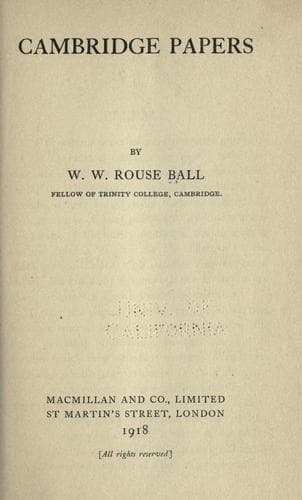
Cambridge PapersBall, W. W. Rouse (Walter William Rouse)
History
Cambridge Papers
Ball, W. W. Rouse (Walter William Rouse)
Trinity College (University of Cambridge); University of Cambridge -- History
As yet Newton had dealt with the problem as if the sun and the planets
might be regarded as heavy masses concentrated at their centres.
Clearly at the best this was only an approximation, though considering
the enormous distances involved it was not unreasonable. In January or
February, 1685, he considered the question of the attraction of bodies
of finite size, and found, to his surprise and gratification, that
a sphere or spherical shell attracts an external particle as if
condensed into a heavy mass at its centre. Hence the results he had
already proved for the relative motion of particles were true for the
solar system, save for small errors due partly to the fact that the
bodies were not perfectly spherical and partly to disturbances caused
by the planets attracting one another. It was no longer a question of
rough approximation: the problem was reducible to mathematical
analysis, subject to the introduction of minute corrections, which,
given the necessary observations, could be calculated very closely.
This was a new discovery of first-rate importance, and initiated the
modern theory of attractions.
The first book of the _Principia_ was finished before the summer of
1685. It deals with the motion of particles or bodies in free space
either in known orbits or under the action of known forces. In it
the law of attraction is generalized into the statement that every
particle of matter attracts every other particle with a force which
varies directly as the product of their masses and inversely as the
square of the distance between them. Thus gravitation was brought into
the domain of Science.
The second book was completed by the summer of 1686. It treats of
motion in a resisting medium and of various problems connected with
waves. At the end of it, it is shown that the Cartesian theory of
vortices is inconsistent with the laws of motion, and necessarily
leads to incorrect results. This book opened another world to the
application of mathematics and, in effect, created the science of
hydrodynamics.
The third book was finished in March 1687. In this, the theorems
previously established are applied to the chief phenomena of the
universe, and briefly we may say that all the facts then known about
the solar system and, in particular, the motion of the moon with its
various inequalities, the figure of the earth, and the phenomena of
the tides, were shown to be in accord with the theory. Much of the
material for these calculations was collected by Flamsteed and Halley.
Public-domain text, read in full here on John Shaqi.
Reviews
Reviews
No reviews yet
Be the first to share your thoughts on this work.
Elsewhere in the archive
Join the Discussion
Join the discussion
Sign in to leave a comment or review.
Sign InorCreate an account