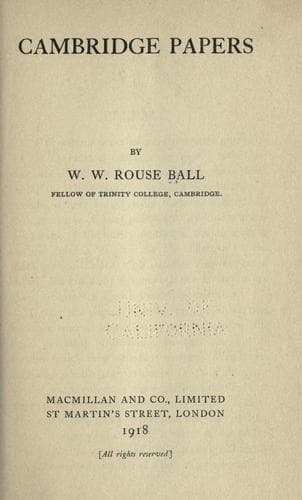
Cambridge PapersBall, W. W. Rouse (Walter William Rouse)
History
Cambridge Papers
Ball, W. W. Rouse (Walter William Rouse)
Trinity College (University of Cambridge); University of Cambridge -- History
In 1679 Newton knew with approximate correctness the value of the
radius of the earth. He repeated his calculations, and found the
results to be in accordance with his former hypothesis. He then
proceeded to the general theory of the motion of a particle under a
force directed to a fixed point, and showed that the vector to the
particle would sweep over equal areas in equal times. He also proved
that, if a particle describes an ellipse under a force directed to a
focus, the law must be that of the inverse square of the distance from
the focus, and conversely, that the orbit of a particle projected in
free space under the influence of such a force must be a conic. The
application to the solar system was obvious, since Kepler had shown
that the planets describe ellipses with the sun in one focus, and that
the vectors from the sun to them sweep over equal areas in equal
times. This investigation was made for his own satisfaction and was
not published at the time. In it he treated the solar bodies as if
they were particles, and he must have realized that the results could
be taken as being only approximately correct.
In 1684 the subject of the planetary orbits was discussed in London
by Halley, Hooke, and Wren. They were aware that, if Kepler's
conclusions were correct, the attraction of the sun or earth on a
distant external particle must vary inversely as the square of the
distance, but they could not determine the orbit of a particle
subjected to the action of a central force of this kind. It was
suggested that Newton might be able to assist them. Accordingly in
August, Halley went to Cambridge for a talk on the subject, and then
found that Newton had solved the problem some five years previously,
and that the path was necessarily a conic. At Halley's request Newton
wrote out the substance of his argument, and sent it to London.
Halley at once realized the importance of the communication, and later
in the autumn returned to Cambridge to urge Newton to prosecute the
theory further. He found that Newton had already done something in the
matter, the results being contained in a manuscript which he saw.
Probably this reference is to the holograph manuscript, still
preserved in the University Library at Cambridge, of Newton's lectures
in the Michaelmas Term, which served as the basis of his memoir sent
to the Royal Society a few months later. The great value of these
investigations was recognized, and Newton was persuaded to attack the
more general problem. His results are given in the _Principia_.
Public-domain text, read in full here on John Shaqi.
Reviews
Reviews
No reviews yet
Be the first to share your thoughts on this work.
Elsewhere in the archive
Join the Discussion
Join the discussion
Sign in to leave a comment or review.
Sign InorCreate an account