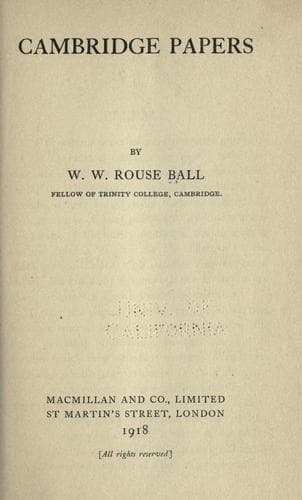
Cambridge PapersBall, W. W. Rouse (Walter William Rouse)
History
Cambridge Papers
Ball, W. W. Rouse (Walter William Rouse)
Trinity College (University of Cambridge); University of Cambridge -- History
was only courteous to give these deposed students the hospitality of
the House, and they occupied a different position to the pensioners
and fellow-commoners who later were admitted in considerable numbers.
We cannot prove or disprove the presence at this time of other
students, but it is most likely that at first there were no residents
in College other than those mentioned above.
The legal formalities connected with the surrender of the properties
of King's Hall and Michael-House took a considerable time, and were
not completed till 17 December 1546. The letters patent founding the
College and the charter of dotation were signed a few days later[15].
The actual endowment granted was valued at £1640 net a year, which
must have been deemed ample to provide for the expenses and the
maintenance of the House. Comparing this income and the estimated
expenditure with those of King's Hall and Michael-House we gather how
much more important than these colleges was the contemplated new
foundation.
Thus were King's Hall and Michael-House dissolved, but only to be
merged in a new and nobler Society. The letters patent founding
Trinity College state that Henry to the glory and honour of Almighty
God and the Holy and Undivided Trinity, for the amplification and
establishment of the Christian and true religion, the extirpation of
heresy and false opinion, the increase and continuance of divine
learning and all kinds of godliness, the knowledge of language, the
education of youth in piety virtue discipline and learning, the relief
of the poor and destitute, the prosperity of the Church of Christ, and
the common good and happiness of his kingdom and subjects, founded and
established a College of letters, sciences, philosophy; godliness, and
sacred theology, for all time to endure. These are noble objects, and
we may look back with honourable pride to the way in which Trinity
College has on the whole carried out the intentions of its founder.
The organization of the new College followed closely that outlined in
the _Distribucio_. To meet the expenses already incurred during the
Michaelmas term the Court of Augmentations[16] in January 1547 paid
Redman £590 "towards the exhibition of King's Scholars in Cambridge."
This was about one-third of the total intended income of the House,
and presumably cleared matters up to 24 December 1546, when the
College entered into possession of its endowments. If we may trust the
sermon preached in London on 12 December 1550, by Thomas Lever,
subsequently master of St John's College, Trinity had reason to regret
the death of Henry in January 1547, for the preacher asserted that a
substantial part of the intended endowment was appropriated by
courtiers in London; I have never investigated what part (if any) of
it was thus lost to the College.
Public-domain text, read in full here on John Shaqi.
Reviews
Reviews
No reviews yet
Be the first to share your thoughts on this work.
Join the Discussion
Join the discussion
Sign in to leave a comment or review.
Sign InorCreate an account