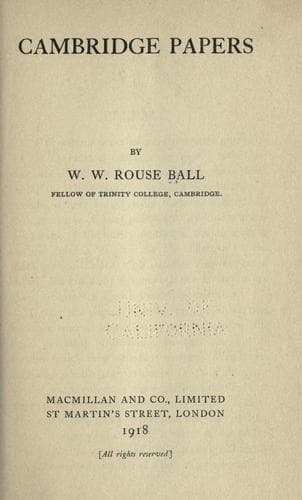
Cambridge PapersBall, W. W. Rouse (Walter William Rouse)
History
Cambridge Papers
Ball, W. W. Rouse (Walter William Rouse)
Trinity College (University of Cambridge); University of Cambridge -- History
The first section is on the method of prime and ultimate ratios, by
the use of which Newton was able, in effect, to integrate. He applied
this to the curvature and the areas of curves, and proved that, at
the very beginning of the motion of a body from rest under any force,
the space described is proportional to the force and the square of the
time.
The second section is concerned with the motion of a particle under a
central force. It contains the well-known propositions that if the
force is central the area swept out by the vector to the centre is
proportional to the time, and conversely that if such area is
proportional to the time the particle is acted on by a central force.
Newton further discussed particular cases of circular, elliptic, and
spiral motion. In the third section he dealt with motion in a conic
under a central force to the focus, showed that in this case the force
must vary inversely as the square of the distance, and conversely that
if a particle be projected from any point in any direction with any
velocity under such a force it must describe a conic about the centre
of force as a focus, and that in such elliptic orbits the periodic
times are in the sesquiplicate ratio of the major axes of the
ellipses. He also explained how to treat the problem if disturbing
forces are introduced. These two sections solved the problem of
planetary motion if the planets could be treated as particles and did
not disturb one another's motions.
The fourth and fifth sections are given up to the proof of certain
geometrical propositions in conics required for subsequent
discussions: in particular the construction of a conic when a focus
and three other conditions or when five points on it or five tangents
to it are given.
In the sixth section Newton returned to the problem of the motion of a
particle in an ellipse under a central force to a focus, and discussed
how to determine the position of the particle at any given time.
(Kepler's Problem.)
The seventh and eighth sections are devoted to the motion of a
particle under a central force which is any function of the distance.
The geometrical treatment of these problems is ingenious, but
necessarily more involved than when modern analysis is used.
In the ninth section Newton dealt with the motion of particles in
orbits which are revolving about the centre of force, and on the
motion of the apses of such orbits: this introduced the theory of
disturbing forces. The tenth section is concerned with constrained
motion, and particularly with the motion of pendulums. The eleventh
section deals with the motion of particles under their mutual
attractions and incidentally with the problem of three bodies. These
three sections afford a notable illustration of Newton's analytical
powers.
Public-domain text, read in full here on John Shaqi.
Reviews
Reviews
No reviews yet
Be the first to share your thoughts on this work.
Elsewhere in the archive
Join the Discussion
Join the discussion
Sign in to leave a comment or review.
Sign InorCreate an account