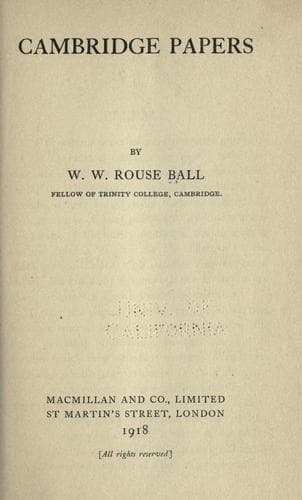
Cambridge PapersBall, W. W. Rouse (Walter William Rouse)
History
Cambridge Papers
Ball, W. W. Rouse (Walter William Rouse)
Trinity College (University of Cambridge); University of Cambridge -- History
The twelfth and thirteenth sections deal with the attraction under
various laws of force of spherical bodies, circular laminae, and
solids of revolution. These sections brought the problem of the solar
system, consisting of solid bodies of finite size and approximately
spherical in form, into the domain of mathematics, and led up to the
generalization that all particles of matter attract one another with a
force proportional to the product of their masses and inversely
proportional to the square of the distance between them, from which
law it would seem that all the known phenomena of the motions of the
solar system can be deduced.
The fourteenth section is concerned with the motion of minute
corpuscles, with applications to the corpuscular theory of light.
The second book is devoted to the discussion of the motion of bodies
in resisting mediums: there are fifty-three propositions besides
lemmas, scholia, etc.
In the first section, Newton considered the motion of a particle or
sphere moving in a medium whose resistance varies as the velocity of
the particle: in the second section the resistance is assumed to vary
as the square of the velocity: and in the third section the resistance
is supposed to consist of two terms, one varying as the velocity and
the other as the square of the velocity. The fourth section is on
spiral motion caused by resistance of the medium.
The fifth section deals with the density and pressure of liquids and
gases at rest (Hydrostatics).
The sixth section treats of the motion of pendulums in a resisting
medium; and the seventh section is concerned with the motion of
fluids, and the resistance they offer to the motion of projectiles.
The latter section contains the celebrated statement of the form of
the solid of least resistance, whose demonstration proved a puzzle to
mathematicians until the invention of the calculus of variations.
Newton's solution is in the Portsmouth papers, and elsewhere I have
published it: it involves the use of fluxions, and it is probable that
it was his failure to translate this demonstration into geometrical
language that led him to give the result without a proof.
The eighth section deals with the motion of waves with applications to
the theory of sound and the undulatory theory of light; and the ninth
section deals with vortices; it is here shown that the theory of
vortices suggested by Descartes to explain the motion of the solar
system is untenable.
This book created the theory of hydrodynamics. Much of it is
incomplete, but it is astonishing that Newton proved as much as he
did; of course to-day no one would suggest that the best way of
attacking these problems is by Newtonian geometrical methods.
Public-domain text, read in full here on John Shaqi.
Reviews
Reviews
No reviews yet
Be the first to share your thoughts on this work.
Elsewhere in the archive
Join the Discussion
Join the discussion
Sign in to leave a comment or review.
Sign InorCreate an account