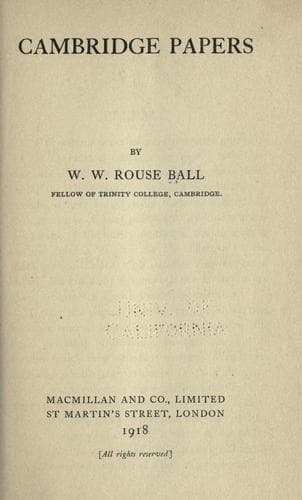
Cambridge PapersBall, W. W. Rouse (Walter William Rouse)
History
Cambridge Papers
Ball, W. W. Rouse (Walter William Rouse)
Trinity College (University of Cambridge); University of Cambridge -- History
"All these lectures to consist in extemporary explications of books in
such an easy, short, and clear manner as may be most profitable to the
auditors. And if any Lecturer or other person shall compose any
treatise which shall be preferred and used by the major part of the
Mathematic or Philosophic Lecturers, the University shall give the
author either £20, or if those Lecturers request it, £30, £40 or £50,
out of their Common Chest.
"Commissioners to be appointed for some years to set on foot, inspect,
and amend the institution.
"No oaths of office to be imposed on the Lecturers. I do not know a
greater abuse of religion than that sort of oaths: they being harder
to be kept than the Jewish Law, so that yearly absolutions have been
instituted. The papists, who believe such absolutions, might be
excused for instituting such oaths, but we have no such doctrine, and
yet continue their practices. Admonitions and pecuniary mulcts for
neglect of duty are less cruel punishments than the consequence of
perjury, and may be as effectual."
[Footnote 33: Camb. Univ. Library, Newton MSS. section viii, No. 5.
Add. 4005/6, A.]
CHAPTER XV.
THE HISTORY OF THE MATHEMATICAL TRIPOS.
The Mathematical Tripos has played so prominent a part in the history
of education at Cambridge and of mathematics in England, that a sketch
of its development[34] may be interesting to general readers.
So far as mathematics is concerned the history of the University
before Newton may be summed up very briefly. The University was
founded towards the end of the twelfth century. Throughout the middle
ages, the instruction given to students was organized on lines similar
to those current at Paris and Oxford, and to qualify for a degree it
was necessary to perform various exercises, and especially to keep a
number of _acts_ or to oppose acts kept by other students. An act
consisted in effect of a debate in Latin, thrown, at any rate in
later times, into syllogistic form. It was commenced by one student,
the _respondent_, stating some proposition, often propounded in the
form of a thesis, which was attacked by an _opponent_ or _opponents_,
the discussion being controlled by a senior graduate. The teaching was
largely in the hands of young graduates--every master of arts being
compelled to reside and teach for at least one year--though no doubt
colleges and private hostels supplemented this instruction in the case
of their own students.
Public-domain text, read in full here on John Shaqi.
Reviews
Reviews
No reviews yet
Be the first to share your thoughts on this work.
Elsewhere in the archive
Join the Discussion
Join the discussion
Sign in to leave a comment or review.
Sign InorCreate an account