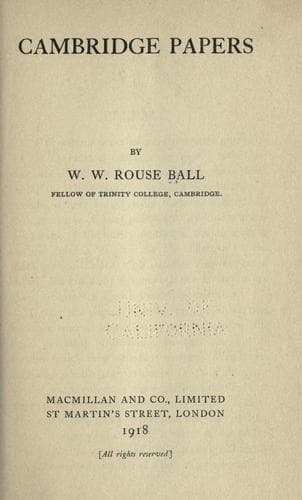
Cambridge PapersBall, W. W. Rouse (Walter William Rouse)
History
Cambridge Papers
Ball, W. W. Rouse (Walter William Rouse)
Trinity College (University of Cambridge); University of Cambridge -- History
The reformation in England was largely the work of Cambridge divines,
and in the University the renaissance was warmly welcomed. In spite of
the disorder and confusion of the Tudor period, new studies and a
system of professional instruction were introduced. The earliest
lectureships created by the University seem to have been one in Latin
established in or before 1492 and one in mathematics established in or
before 1501: they mark the beginning of the system of teaching by
experts which has superseded the medieval system of compulsory
teaching by all regent masters. The fact that one of these
lectureships was in mathematics shows that as early as 1500 the
subject was regarded as important. Tunstall, subsequently the most
eminent English arithmetician of his time, migrated in 1496 from
Oxford to Cambridge, and most of the subsequent English
mathematicians of the Tudor period were at Cambridge; of these I may
mention Record (who migrated, probably about 1535, from Oxford), Dee,
Digges, Blundeville, Buckley, Billingsley, Hill, Bedwell, Hood,
Richard and John Harvey, Edward Wright, Briggs, and Oughtred. Under
the Elizabethan statutes of 1570, notwithstanding many disadvantages,
the mathematical school continued to grow. Horrox, Seth Ward, Foster,
Rooke, Gilbert Clerke, Pell, Wallis, Barrow, Dacres, and Morland may
be cited as prominent Cambridge mathematicians of the succeeding
century.
Newton's mathematical career dates from 1665; his reputation,
abilities, and influence attracted general attention to the subject.
He created a school of mathematics and mathematical physics, among the
earliest members of which I note the names of Laughton, Samuel Clarke,
Craig, Flamsteed, Whiston, Saunderson, Jurin, Taylor, Cotes, and
Robert Smith. Since then Cambridge has been regarded as, in a special
sense, the home of English mathematicians, and from 1706 onwards we
have fairly complete accounts of the course of reading and work of
mathematical students.
Until less than a century ago the form of the method of qualifying for
a degree remained substantially unaltered, but the subject-matter of
the discussions varied from time to time with the prevalent studies
of the place.
Public-domain text, read in full here on John Shaqi.
Reviews
Reviews
No reviews yet
Be the first to share your thoughts on this work.
Elsewhere in the archive
Join the Discussion
Join the discussion
Sign in to leave a comment or review.
Sign InorCreate an account