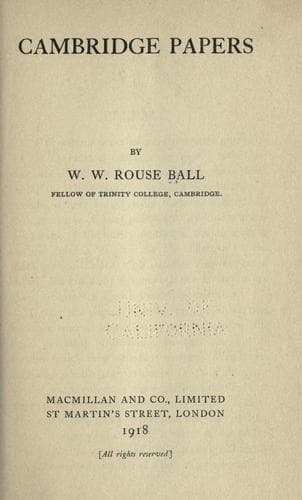
Cambridge PapersBall, W. W. Rouse (Walter William Rouse)
History
Cambridge Papers
Ball, W. W. Rouse (Walter William Rouse)
Trinity College (University of Cambridge); University of Cambridge -- History
After the renaissance some of the statutable exercises were "huddled,"
that is, were reduced to a mere form. To huddle an act, the proctor
generally asked some question such as _Quid est nomen?_ to which the
answer usually expected was _Nescio_. In these exercises considerable
license was allowed, particularly if there were any play on the words
involved. For example, J. Brass, of Trinity, was accosted with the
question, _Quid est aes?_ to which he answered, _Nescio nisi finis
examinationis_. It should be added that retorts such as these were
only allowed in the pretence exercises, and a candidate who in the
actual examination was asked to give a definition of happiness and
replied, "An exemption from Payne"--that being the name of his
questioner--was plucked for want of discrimination in time and place.
In earlier years even the farce of huddling seems to have been
unnecessary, for it was said in 1675 that it was not uncommon for the
proctors to take "cautions for the performance of the statutable
exercises, and accept the forfeit of the money so deposited in lieu of
their performance."
In medieval times acts had been usually kept on some scholastic
question or on a proposition taken from the _Sentences_. About the
end of the fifteenth century religious questions, such as the
interpretation of biblical texts, began to be introduced. Some fifty
or sixty years later the favourite subjects were drawn either from
dogmatic theology or from philosophy. In the seventeenth century the
questions were usually philosophical, but in the eighteenth century,
under the influence of the Newtonian school, a large proportion of
them were mathematical.
Further details about these exercises and specimens of acts kept in
the eighteenth century are given in my _History of Mathematics at
Cambridge_. Here I will only say that they provided an admirable
training in the art of presenting an argument, and in dialectical
skill in attack and defence. The mental strain involved in keeping a
contested act was severe. De Morgan, describing his act kept in 1826,
wrote[35]:
I was badgered for two hours with arguments given and answered in
Latin--or what we call Latin--against Newton's first section,
Lagrange's derived functions, and Locke on innate principles. And
though I took off everything, and was pronounced by the moderator to
have disputed _magno honore_, I never had such a strain of thought
in my life. For the inferior opponents were made as sharp as their
betters by their tutors, who kept lists of queer objections drawn
from all quarters.
Had the language of the discussions been changed to English, as was
repeatedly urged from 1774 onwards, these exercises might have been
retained with advantage, but the barbarous Latin and the syllogistic
form in which they were carried on prejudiced their retention.
Public-domain text, read in full here on John Shaqi.
Reviews
Reviews
No reviews yet
Be the first to share your thoughts on this work.
Elsewhere in the archive
Join the Discussion
Join the discussion
Sign in to leave a comment or review.
Sign InorCreate an account