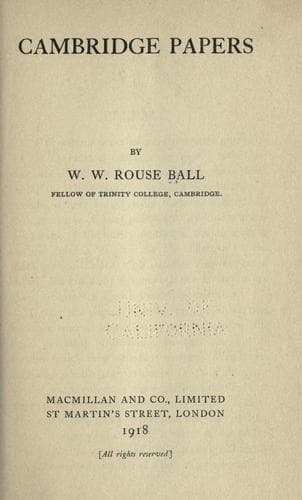
Cambridge PapersBall, W. W. Rouse (Walter William Rouse)
History
Cambridge Papers
Ball, W. W. Rouse (Walter William Rouse)
Trinity College (University of Cambridge); University of Cambridge -- History
From the earliest times the proctors had the power of questioning a
candidate at the end of a disputation, and probably all candidates for
a degree attended the public schools on certain days to give an
opportunity to the proctors (or any master who liked to take part in
the examination) to examine them[37], though the opportunity was not
always used. Such examinations were conducted in Latin, and originally
different candidates attended on different days. Soon after 1710[38]
the moderators or proctors began the custom of summoning on one day in
January all candidates whom they proposed to question, and conducting
the examination in English and in public: the examination did not last
more than one day, and was partly on philosophy and partly on
mathematics. It was from this examination that the Mathematical Tripos
developed.
This introduction of a regular oral examination seems to have been
mainly due to the fact that when, in 1710, George I gave the Ely
library to the University, it was decided to assign for its reception
the old senate-house--now the catalogue room in the library--and to
build a new room for the meetings of the senate. Pending the building
of the new senate-house the books were stored in the Schools, which
thus were rendered unavailable for keeping acts. In consequence of
this, considerable difficulty was found in arranging for all the
candidates to keep the full number of statutable exercises, and
obtaining opportunities to compare them one with another: hence the
introduction or extension of a supplementary oral examination. The
advantages of this examination as providing a ready means of testing
the knowledge and abilities of the candidates were so patent that it
was retained when the necessity for some system of the kind had passed
away, and finally it became systematized into an organized test to
which all questionists were subjected.
In 1731 the University raised the joint stipend of the moderators to
£60 "in consideration of their additional trouble in the Lent Term."
This would seem to indicate that the senate-house examination had then
taken formal shape, and perhaps that a definite scheme for its conduct
had become customary.
Public-domain text, read in full here on John Shaqi.
Reviews
Reviews
No reviews yet
Be the first to share your thoughts on this work.
Elsewhere in the archive
Join the Discussion
Join the discussion
Sign in to leave a comment or review.
Sign InorCreate an account