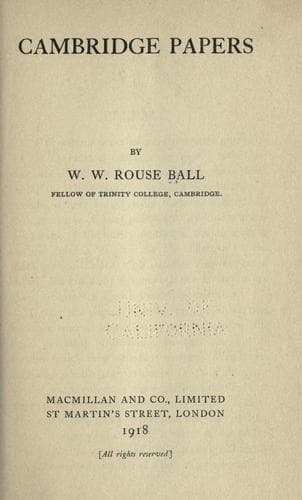
Cambridge PapersBall, W. W. Rouse (Walter William Rouse)
History
Cambridge Papers
Ball, W. W. Rouse (Walter William Rouse)
Trinity College (University of Cambridge); University of Cambridge -- History
As long as the order of the list of those approved for degrees was
settled on the result of impressions derived from acts kept by the
different candidates at different times and on different subjects, it
was impossible to arrange the men in strict order of merit, nor was
much importance attached to the order. But, with the introduction of
an examination of all the candidates on one day, much closer attention
was paid to securing an accurate classification, and more confidence
felt in the published order. It seems to have been consequent on this
that in and after 1748 the final lists were regarded as authoritative
and important and that the names of the honorary optimes were
definitely indicated: the lists from this time appeared in the
_University Calendars_. The lists from 1748 to 1910, with the earlier
Ordines Senioritatis from 1499 to 1747, are printed in the _Historical
Register of the University_.
Of the detailed history of the examination until the middle of the
eighteenth century we know nothing. From 1750 onwards, however, we
have more definite accounts of it. At this time, it would seem that
all the men from each college were taken together as a class, and
questions passed down by the proctors or moderators till they were
answered: but the examination remained entirely oral, and technically
was regarded as subsidiary to the discussions which had been
previously held in the schools.
Each class contained men of very different abilities, and to meet
difficulties thus caused, a custom grew up by which every candidate
was liable to be taken aside to be questioned by any master of arts
who wished to do so, and this was regarded as an important part of the
examination. The examination now continued for two days and a half,
the subjects, as before, being mathematics and philosophy. At the
conclusion of the second day the moderators received the reports of
those masters of arts who had voluntarily taken part in the
examination, and provisionally settled the final list. The last
half-day was used in revising and rearranging the order of merit.
Richard Cumberland has left an account of the tests to which he was
subjected when he took his bachelor degree in 1751. Clearly the
disputations still played an important part, and it is difficult to
say what weight was attached to the subsequent senate-house
examination; his reference to it is only of a general character. After
saying that he kept two acts and two opponencies he continued[39]:
Public-domain text, read in full here on John Shaqi.
Reviews
Reviews
No reviews yet
Be the first to share your thoughts on this work.
Elsewhere in the archive
Join the Discussion
Join the discussion
Sign in to leave a comment or review.
Sign InorCreate an account