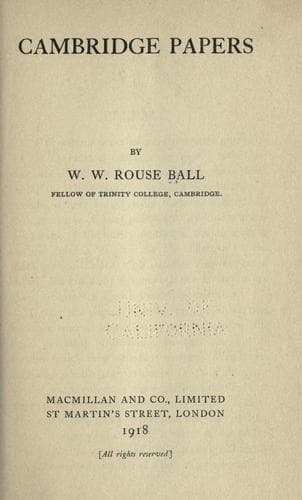
Cambridge PapersBall, W. W. Rouse (Walter William Rouse)
History
Cambridge Papers
Ball, W. W. Rouse (Walter William Rouse)
Trinity College (University of Cambridge); University of Cambridge -- History
All the men from one college were no longer taken together, but each
class was examined separately and _vivâ voce_; and hence, since all
the students comprised in each class were of about equal attainments,
it was possible to make the examination more effective. Richard
Watson, of Trinity, claimed that this change was made by him when
acting as moderator in 1763. He said[41]:
There was more room for partiality ... then [_i.e._ in 1759] than
there is now; and I attribute the change, in a great degree, to an
alteration which I introduced the first year I was moderator [_i.e._
in 1763], and which has been persevered in ever since. At the time
of taking their Bachelor of Arts' degree, the young men are examined
in classes, and the classes are now formed according to the
abilities shown by individuals in the schools. By this arrangement,
persons of nearly equal merits are examined in the presence of each
other, and flagrant acts of partiality cannot take place. Before I
made this alteration, they were examined in classes, but the classes
consisted of members of the same College, and the best and worst
were often examined together.
It is probable that before the examination in the senate-house began
a candidate, if manifestly placed in too low a class, was allowed the
privilege of challenging the class to which he was assigned. Perhaps
this began as a matter of favour, and was only granted in exceptional
cases, but a few years later it became a right which every candidate
could exercise; and I think that it is partly to its development that
the ultimate predominance of the tripos over the other exercises for
the degree is due.
In the same year, 1763, it was decided that the relative position of
the senior and second wranglers, namely, Paley, of Christ's, and
Frere, of Caius, was to be decided by the senate-house examination and
not by the disputations. Henceforward distinction in that examination
was regarded as the most important honour open to undergraduates.
In 1768 Robert Smith, of Trinity College, founded prizes for
mathematics and natural philosophy open to two commencing bachelors.
The examination followed immediately after the senate-house
examination, and the distinction, being much coveted, tended to
emphasize the mathematical side of the normal university education of
the best men. Since 1883 the prizes have been awarded on the result of
dissertations[42]. Additional prizes, awarded at the same time, and
associated with the name of Lord Rayleigh[43], were founded in 1909.
Public-domain text, read in full here on John Shaqi.
Reviews
Reviews
No reviews yet
Be the first to share your thoughts on this work.
Elsewhere in the archive
Join the Discussion
Join the discussion
Sign in to leave a comment or review.
Sign InorCreate an account