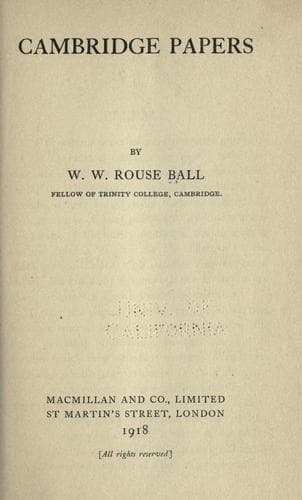
Cambridge PapersBall, W. W. Rouse (Walter William Rouse)
History
Cambridge Papers
Ball, W. W. Rouse (Walter William Rouse)
Trinity College (University of Cambridge); University of Cambridge -- History
The last time I was called upon to keep an act in the schools I sent
in three questions to the Moderator, which he withstood as being all
mathematical, and required me to conform to the usage of proposing
one metaphysical question in the place of that, which I should think
fit to withdraw. This was ground I never liked to take, and I
appealed against his requisition: the act was accordingly put by
till the matter of right should be ascertained by the statutes of
the university, and in the result of that enquiry it was given for
me, and my question stood.... I yielded now to advice, and paid
attention to my health, till we were cited to the senate house to be
examined for our Bachelor's degree. It was hardly ever my lot during
that examination to enjoy any respite. I seemed an object singled
out as every man's mark, and was kept perpetually at the table under
the process of question and answer.
It was found possible by means of the new examination to differentiate
the better men more accurately than before; and accordingly, in 1753,
as above stated, the first class was subdivided into two, called
respectively wranglers and senior optimes, a division which is still
maintained.
The semi-official examination by masters of arts was regarded as the
more important part of the test, and the most eminent residents in the
University took part in it. Thus John Fenn, of Caius, 5th wrangler in
1761, wrote[40]:
On the following Monday, Tuesday, and Wednesday, we sat in the
Senate-house for public examination; during this time I was
officially examined by the Proctors and Moderators, and had the
honour of being taken out for examination by Mr Abbot, the
celebrated mathematical tutor of St John's College, by the eminent
professor of mathematics Mr Waring, of Magdalene, and by Mr Jebb of
Peterhouse, a man thoroughly versed in the academical studies.
This irregular examination by any master who chose to take part in it
constantly gave rise to accusations of partiality.
In 1763 the traditional rules for the conduct of the examination took
more definite shape. Henceforth the examiners used the disputations
only as a means of classifying the men roughly. On the result of their
"acts," and probably partly also of their general reputation, the
candidates were divided into eight classes, each arranged in
alphabetical order. The subsequent position of the men in the class
was determined solely by the senate-house examination. The first two
classes comprised all who were expected to be wranglers, the next four
classes included the other candidates for honours, and the last two
classes consisted of poll-men only. Practically anyone placed in
either of the first two classes was allowed, if he wished, to take an
aegrotat senior optime, and thus escape all further examination: this
was called gulphing it.
Public-domain text, read in full here on John Shaqi.
Reviews
Reviews
No reviews yet
Be the first to share your thoughts on this work.
Elsewhere in the archive
Join the Discussion
Join the discussion
Sign in to leave a comment or review.
Sign InorCreate an account