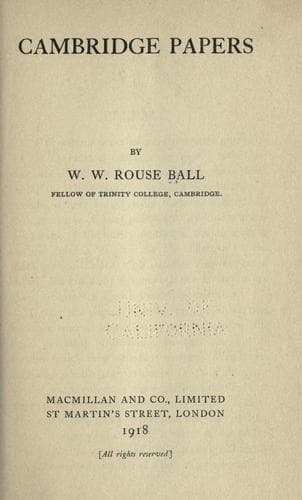
Cambridge PapersBall, W. W. Rouse (Walter William Rouse)
History
Cambridge Papers
Ball, W. W. Rouse (Walter William Rouse)
Trinity College (University of Cambridge); University of Cambridge -- History
The examination is varied according to the abilities of the
students. The moderator generally begins with proposing some
questions from the six books of Euclid, plain (_sic_) trigonometry,
and the first rules of algebra. If any person fails in an answer,
the question goes to the next. From the elements of mathematics,
a transition is made to the four branches of philosophy, viz.
mechanics, hydrostatics, apparent astronomy, and optics, as
explained in the works of Maclaurin, Cotes, Helsham, Hamilton,
Rutherforth, Keill, Long, Ferguson, and Smith. If the moderator
finds the set of questionists, under examination, capable of
answering him, he proceeds to the eleventh and twelfth books of
Euclid, conic sections, spherical trigonometry, the higher parts of
Algebra, and sir Isaac Newton's Principia; more particularly those
sections, which treat of the motion of bodies in eccentric and
revolving orbits; the mutual action of spheres, composed of
particles attracting each other according to various laws; the
theory of pulses, propagated through elastic mediums; and the
stupendous fabric of the world. Having closed the philosophical
examination, he sometimes asks a few questions in Locke's Essay on
the human understanding, Butler's Analogy, or Clarke's Attributes.
But as the highest academical distinctions are invariably given to
the best proficients in mathematics and natural philosophy, a very
superficial knowledge in morality and metaphysics will suffice.
When the division under examination is one of the highest classes,
problems are also proposed, with which the student retires to a
distant part of the senate-house, and returns, with his solution
upon paper, to the moderator, who, at his leisure, compares it with
the solutions of other students, to whom the same problems have been
proposed.
The extraction of roots, the arithmetic of surds, the invention of
divisers, the resolution of quadratic, cubic, and biquadratic
equations; together with the doctrine of fluxions, and its
application to the solution of questions "de maximis et minimis,"
to the finding of areas, to the rectification of curves, the
investigation of the centers of gravity and oscillation, and to the
circumstances of bodies, agitated, according to various laws, by
centripetal forces, as unfolded, and exemplified, in the fluxional
treatises of Lyons, Saunderson, Simpson, Emerson, Maclaurin, and
Newton, generally form the subject matter of these problems.
When the clock strikes nine, the questionists are dismissed to
breakfast: they return at half-past nine, and stay till eleven; they
go in again at half-past one, and stay till three; and, lastly, they
return at half-past three, and stay till five.
The hours of attendance are the same upon the subsequent day.
On the third day they are finally dismissed at eleven.
Public-domain text, read in full here on John Shaqi.
Reviews
Reviews
No reviews yet
Be the first to share your thoughts on this work.
Elsewhere in the archive
Join the Discussion
Join the discussion
Sign in to leave a comment or review.
Sign InorCreate an account