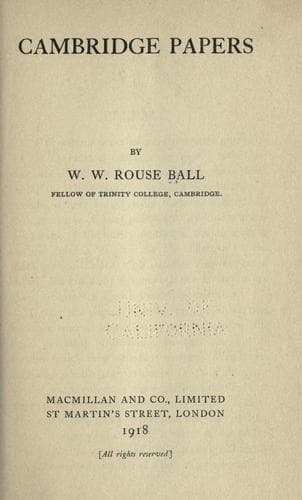
Cambridge PapersBall, W. W. Rouse (Walter William Rouse)
History
Cambridge Papers
Ball, W. W. Rouse (Walter William Rouse)
Trinity College (University of Cambridge); University of Cambridge -- History
During the hours of attendance, every division is twice examined in
form, once by each of the moderators, who are engaged for the whole
time in this employment.
As the questionists are examined in divisions of only six or eight
at a time, but a small portion of the whole number is engaged, at
any particular hour, with the moderators; and, therefore, if there
were no further examination, much time would remain unemployed.
But the moderator's inquiry into the merits of the candidates forms
the least material part of the examination.
The "fathers" of the respective colleges, zealous for the credit of
the societies, of which they are the guardians, are incessantly
employed in examining those students, who appear most likely to
contest the palm of glory with their sons.
This part of the process is as follows:
The father of a college takes a student of a different college
aside, and, sometimes for an hour and an half together, strictly
examines him in every part of mathematics and philosophy, which he
professes to have read.
After he hath, from this examination, formed an accurate idea of the
student's abilities and acquired knowledge, he makes a report of his
absolute or comparative merit to the moderators, and to every other
father who shall ask him the question.
Besides the fathers, all masters of arts, and doctors, of whatever
faculty they be, have the liberty of examining whom they please; and
they also report the event of each trial, to every person who shall
make the inquiry.
The moderators and fathers meet at breakfast, and at dinner. From
the variety of reports, taken in connection with their own
examination, the former are enabled, about the close of the second
day, so far to settle the comparative merits of the candidates, as
to agree upon the names of four-and-twenty, who to them appear most
deserving of being distinguished by marks of academical approbation.
These four-and-twenty [wranglers and senior optimes] are recommended
to the proctors for their private examination; and, if approved by
them, and no reason appears against such placing of them from any
subsequent inquiry, their names are set down in two divisions,
according to that order, in which they deserve to stand; are
afterwards printed; and read over upon a solemn day, in the presence
of the vice-chancellor, and of the assembled university.
The names of the twelve [junior optimes], who, in the course of the
examination, appear next in desert, are also printed, and are read
over, in the presence of the vice-chancellor, and of the assembled
university, upon a day subsequent to the former....
The students, who appear to have merited neither praise nor censure
[the poll-men], pass unnoticed: while those, who have taken no pains
to prepare themselves for the examination, and have appeared with
discredit in the schools, are distinguished by particular tokens of
disgrace.
Public-domain text, read in full here on John Shaqi.
Reviews
Reviews
No reviews yet
Be the first to share your thoughts on this work.
Elsewhere in the archive
Join the Discussion
Join the discussion
Sign in to leave a comment or review.
Sign InorCreate an account