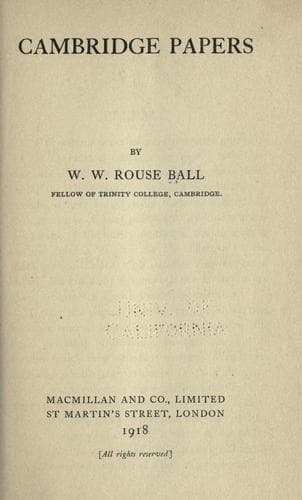
Cambridge PapersBall, W. W. Rouse (Walter William Rouse)
History
Cambridge Papers
Ball, W. W. Rouse (Walter William Rouse)
Trinity College (University of Cambridge); University of Cambridge -- History
It was not long before it became an established custom that a
candidate, who was dissatisfied with the class in which he had been
placed as the result of his disputations, might challenge it before
the examination began. This power seems to have been used but rarely;
it was, however, a recognition of the fact that a place in the tripos
list was to be determined by the senate-house examination alone, and
the examiners soon acquired the habit of settling the preliminary
classes without exclusive reference to the previous disputations.
The earliest extant paper actually set in the senate-house, to which
we can with certainty refer, is a problem paper set in 1785 or 1786 by
W. Hodson, of Trinity, then a proctor. The autograph copy from which
he gave out the questions was luckily preserved, and is in the
library[50] of Trinity College. It must be almost the last problem
paper which was dictated, instead of being printed and given as a
whole to the candidates. The paper is as follows:
1. To determine the velocity with which a Body must be thrown, in
a direction parallel to the Horizon, so as to become a secondary
planet to the Earth; as also to describe a parabola, and never
return.
2. To demonstrate, supposing the force to vary as _1/D²_ how far a
body must fall both within and without the Circle to acquire the
Velocity with which a body revolves in a Circle.
3. Suppose a body to be turned (_sic_) upwards with the Velocity
with which it revolves in an Ellipse, how high will it ascend? The
same is asked supposing it to move in a parabola.
4. Suppose a force varying first as _1/D³_, secondly in a greater
ratio than _1/D²_ but less than _1/D³_, and thirdly in a less ratio
than _1/D²_, in each of these Cases to determine whether at all, and
where the body parting from the higher Apsid will come to the lower.
5. To determine in what situation of the moon's Apsid they go most
forwards, and in what situation of her Nodes the Nodes go most
backwards, and why?
6. In the cubic equation _x³ + qx + r = 0_ which wants the second
term; supposing _x = a + b_ and _3ab = -q_, to determine the value
of _x_. (_sic._)
7. To find the fluxion of _x^r × (y^n + z^m)^{1/q}_.
8. To find the fluent of _aẋ / (a + x)_.
9. To find the fluxion of the _m_^th power of the Logarithm of _x_.
10. Of right-angled Triangles containing a given Area to find that
whereof the sum of the two legs _AB + BC_ shall be the least
possible. [This and the two following questions are illustrated by
diagrams. The angle at _B_ is the right angle.]
11. To find the Surface of the Cone _ABC_. [The cone is a right one
on a circular base.]
12. To rectify the arc _DB_ of the semicircle _DBV_.
Public-domain text, read in full here on John Shaqi.
Reviews
Reviews
No reviews yet
Be the first to share your thoughts on this work.
Elsewhere in the archive
Join the Discussion
Join the discussion
Sign in to leave a comment or review.
Sign InorCreate an account